
Choosing between screen printing and direct-to-garment (DTG) printing represents one of the most consequential decisions for apparel producers, print shop owners, and creative entrepreneurs entering the custom merchandise market. Both methods offer distinct advantages, and understanding their differences can significantly impact your business profitability, production capacity, and overall customer satisfaction.
This comparison provides a detailed examination of investment considerations, scalability factors, and return on investment metrics to help small to medium size businesses and retail consumers make informed production decisions.
Understanding the Fundamentals
Before diving into financial considerations, it is essential to understand how each printing method operates at a technical level.
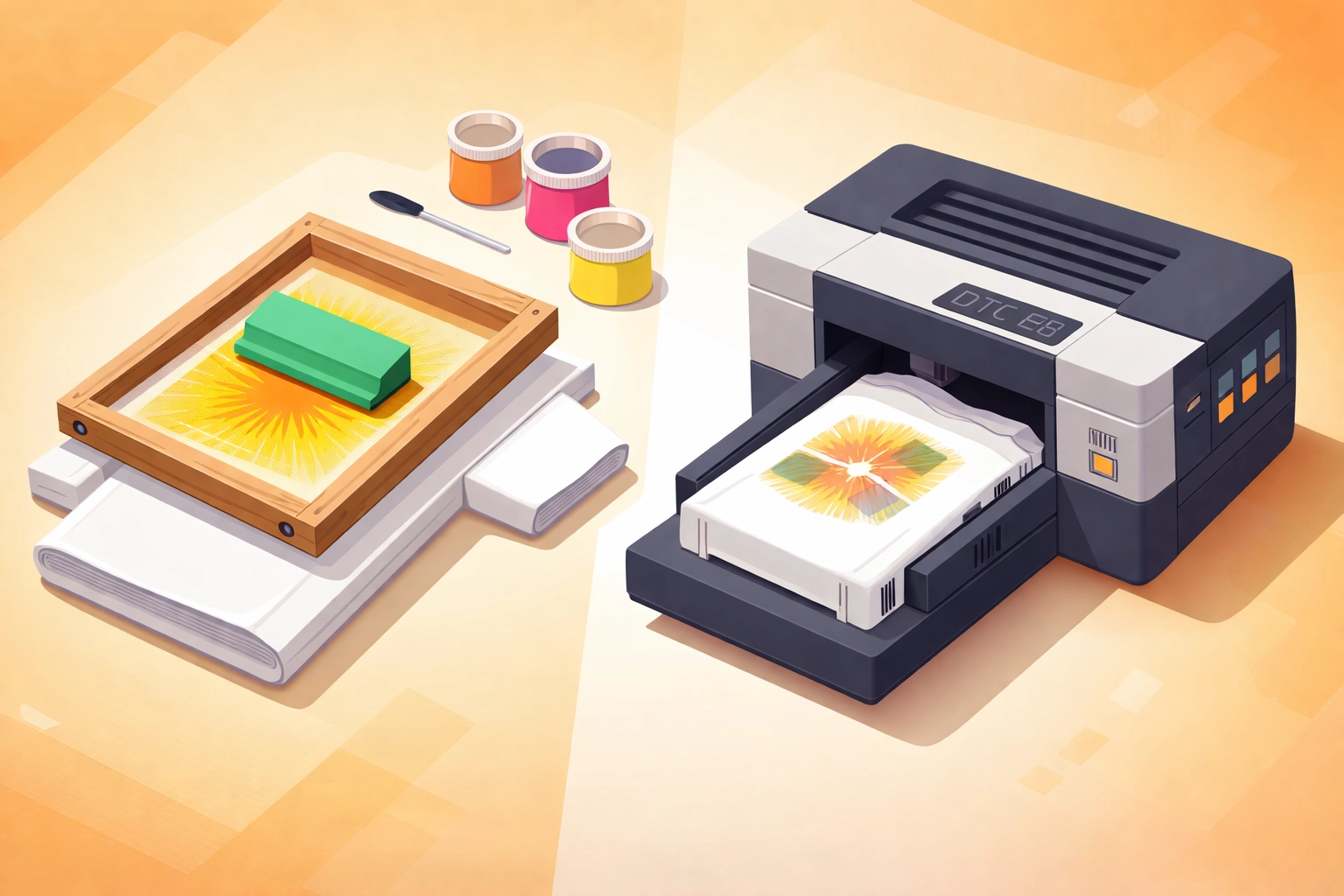
Screen printing is a traditional technique where ink is pushed through a woven mesh screen onto the fabric surface. Each color in your design requires a separate screen, which means artwork must be separated into individual color layers before production begins. The ink sits on top of the fabric fibers, creating a slightly raised, layered appearance that many consumers associate with high quality apparel.
Direct-to-garment printing functions similarly to a standard inkjet printer but is designed specifically for textiles. Water-based ink is sprayed directly onto the garment, where it absorbs into the fabric fibers rather than sitting on top. This absorption creates a soft, smooth finish that becomes part of the garment itself.
Investment and Startup Costs
For small print shops and emerging apparel brands, initial capital requirements often determine which production method is feasible.
Screen Printing Equipment Costs
Establishing a screen printing operation requires a more substantial upfront investment. A basic manual press suitable for small business operations typically ranges from $500 to $3,000, while automatic presses capable of higher volume production can cost between $15,000 and $100,000 or more. Additional equipment requirements include exposure units, washout booths, dryers, and screen reclamation systems.
According to PRINTING United Alliance, the total startup cost for a modest screen printing operation, including equipment, supplies, and workspace preparation, generally falls between $10,000 and $50,000 depending on production goals and quality expectations.
Beyond equipment, screen printing requires ongoing investment in screens, inks, emulsions, and cleaning chemicals. Each new design necessitates the creation of new screens, adding per-project costs that must be factored into pricing strategies.
DTG Equipment Costs
Direct-to-garment printers represent a different investment profile. Entry-level DTG machines suitable for small businesses start around $10,000, while industrial-grade printers capable of higher throughput can exceed $50,000. However, DTG operations require less ancillary equipment, with primary additional costs limited to pretreatment machines, heat presses, and ink supplies.
The simplified equipment requirements of DTG printing often result in lower total startup costs for businesses focused on small batch and custom order production.

Scalability Considerations
Understanding how each method scales is critical for businesses planning growth trajectories.
Screen Printing Scalability
Screen printing demonstrates excellent scalability for high-volume production. Once screens are created and the press is set up, producing additional units becomes increasingly cost-effective. The per-unit cost decreases significantly as order quantities increase, making screen printing the preferred method for bulk orders exceeding several hundred pieces.
However, scaling screen printing operations requires proportional increases in equipment, workspace, and labor. Adding production capacity often means purchasing additional presses and hiring trained operators, which represents significant capital expenditure.
DTG Scalability
DTG printing scales differently. Adding production capacity is relatively straightforward since additional printers can be integrated into existing workflows without extensive infrastructure changes. The technology also supports true on-demand production models, allowing businesses to print single units profitably.
The limitation of DTG scalability lies in throughput speed. Even industrial DTG printers produce garments at a slower rate than automatic screen printing presses running large orders. For businesses anticipating consistent high-volume orders, DTG may present bottlenecks that require multiple machines to overcome.
Performance and Quality Factors
Production method selection should also account for quality outcomes across different applications.
| Factor | Screen Printing | Direct-to-Garment |
|---|---|---|
| Durability | Excellent, lasting years with proper care | Good, though may fade sooner on certain fabrics |
| Fabric Compatibility | Cotton, polyester, nylon, performance blends | Best on 100% cotton or cotton-rich blends |
| Design Complexity | Optimal for bold designs with limited colors | Optimal for photographic and multi-color artwork |
| Feel on Fabric | Thicker, layered texture | Soft, integrated finish |
| Color Vibrancy on Dark Garments | Excellent with proper underbase | Requires pretreatment, results can vary |
Screen printing consistently delivers superior durability, with properly cured prints lasting through hundreds of wash cycles. This longevity makes screen printing particularly suitable for athletic wear, workwear, and merchandise intended for extended use.
DTG printing excels at reproducing complex, photographic, or gradient-heavy designs that would be impractical or prohibitively expensive to screen print. The technology handles unlimited colors at no additional cost, whereas screen printing costs increase with each color added to a design.

Return on Investment Analysis
Calculating ROI requires examining both direct costs and opportunity costs associated with each method.
Screen Printing ROI
The ROI profile for screen printing favors businesses with consistent access to bulk orders. The extensive setup time and screen creation costs mean that small orders rarely generate meaningful profit margins. However, once order volumes exceed approximately 50 to 100 units, the per-unit cost advantage of screen printing becomes substantial.
For a print shop regularly fulfilling orders of 200 or more pieces, screen printing typically delivers stronger profit margins and faster ROI on equipment investments. The durability of screen printed goods also reduces customer complaints and reprint requests, protecting profit margins over time.
DTG ROI
DTG printing offers faster ROI for businesses focused on custom, on-demand, or small batch production. The elimination of setup costs means that even single-unit orders can be profitable when priced appropriately. This characteristic makes DTG particularly valuable for print-on-demand business models and custom merchandise operations.
The trade-off is reduced margin potential on larger orders. Businesses using DTG for bulk production will find per-unit costs remain relatively flat regardless of quantity, limiting the economies of scale available to screen printers.
Making the Decision for Your Business
The optimal production method depends on your specific business model, target market, and growth objectives.
Choose screen printing if:
- Your typical orders exceed 50 to 100 units
- You serve athletic teams, corporate clients, or event organizers requiring bulk quantities
- Your designs feature bold graphics with limited color counts
- Long-term durability is a primary selling point for your customers
- You have adequate workspace and can accommodate extensive equipment
Choose DTG printing if:
- You focus on custom, personalized, or on-demand production
- Your designs frequently include photographic elements or complex color gradients
- Quick turnaround times are essential to your service offering
- You operate with limited space or prefer minimal equipment footprint
- Your business model requires profitability on small order quantities
Many successful print operations ultimately incorporate both methods, using screen printing for bulk orders and DTG for custom and short-run work. This hybrid approach maximizes flexibility and allows businesses to serve diverse customer needs effectively.

Conclusion
Selecting between screen printing and direct-to-garment production is not a matter of identifying which method is universally superior. Instead, the decision should be driven by careful analysis of your order profiles, customer expectations, capital availability, and long-term business objectives.
For detailed guidance on developing your apparel brand or print business, explore additional resources at Creative Design Hub or review our project portfolio to see how strategic design decisions support successful brand development.
Works Cited
PRINTING United Alliance. (2024). State of the industry report: Screen printing and digital textile printing trends. PRINTING United Alliance Publications.
PRINTING United Alliance. (2023). Equipment investment guide for emerging print businesses. PRINTING United Alliance Technical Resources.
Roper, M. (2023). Direct-to-garment printing: Technology overview and best practices. Journal of Textile and Apparel Technology and Management, 12(3), 45-62.
Screen Printing Technical Foundation. (2024). Screen printing process standards and specifications (8th ed.). SPTF Press.
Recent Comments