
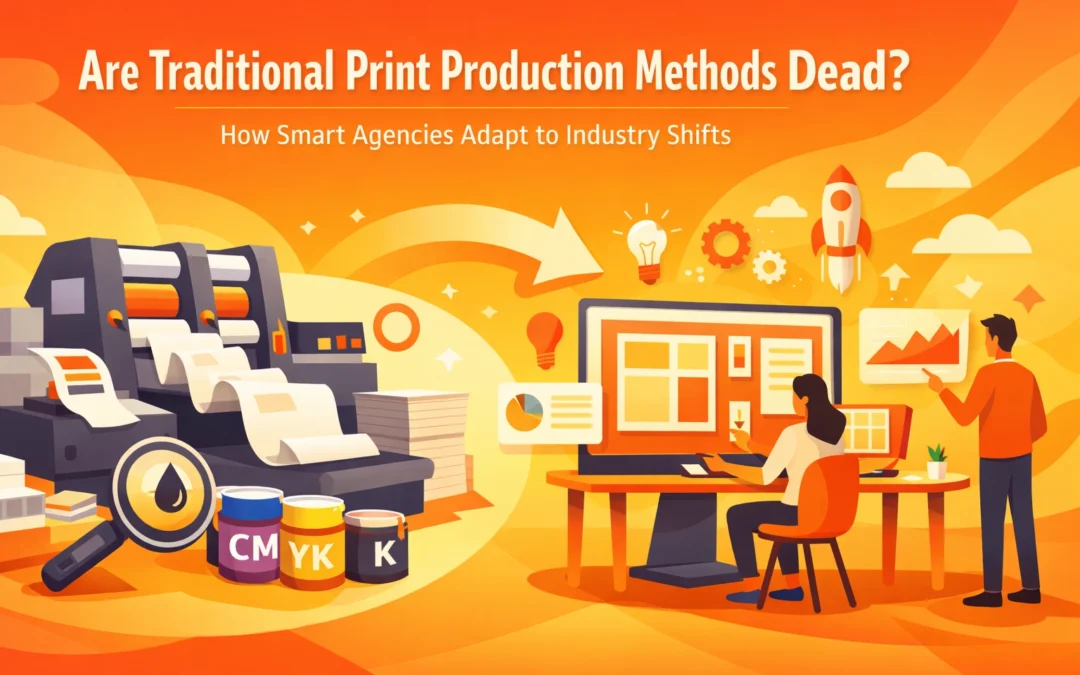
The question surfaces repeatedly at industry conferences and roundtables: are traditional print production methods dead? The short answer is nuanced. Traditional offset printing and manual production workflows are not extinct, but they occupy a rapidly shrinking footprint in an industry undergoing fundamental transformation. Agencies that recognize this shift and strategically adapt are capturing growth opportunities, while those clinging exclusively to legacy methods face increasing obsolescence.
The Digital Acceleration Is Quantifiable
Digital printing technologies are displacing traditional methods at an accelerating pace. According to projections from PRINTING United Alliance, digital print will account for 22.5% of the global value of all print and printed packaging by 2035, representing an increase of nearly 50% from $167.5 billion in 2025 to $251.1 billion within a decade (PRINTING United Alliance, 2024). Traditional offset printing will feel sustained pressure as digital alternatives prove more efficient across multiple production variables.
The migration among commercial printers reveals strategic intent. In planned inkjet adoption strategies, 57% of printers aim to move offset work to inkjet production, 47% seek lower cost of ownership compared to toner technologies, and 43% want to accommodate demand for short runs (Keypoint Intelligence, 2024). Printers operating production inkjet systems report tangible benefits: a 10% average decrease in production waste and a 9.4% increase in profitability.
These numbers reflect operational realities, not abstract trends. Digital production enables variable run lengths, drastically reduces setup times, and eliminates the plate creation process that makes offset printing economically viable only at higher volumes. The cost crossover point where digital becomes more economical than offset continues to rise as technology improves and pricing becomes more competitive.
Where Traditional Methods Retain Value
Despite the digital surge, traditional craftsmanship retains niche value in specific market segments. Letterpress printing, screen printing, and other hands-on techniques offer superior tactile qualities, nuanced textures, and color depth that some digital methods cannot replicate (Print Magazine, 2023). High-end invitations, limited edition art prints, and premium packaging often justify traditional production methods based on aesthetic differentiation alone.
Traditional techniques also provide sustainability advantages in certain applications. Higher-quality materials produced through traditional methods can be more durable and reduce waste over time compared to lower-quality digital alternatives. However, this segment remains marginal as the workforce skilled in traditional techniques continues to shrink and training programs disappear.
The reality is that traditional methods survive where they deliver distinctive value that justifies premium pricing. They do not compete effectively on speed, customization, or cost efficiency for mainstream production work.
Strategic Adaptation #1: Automation and Workflow Integration
Forward-thinking agencies prioritize finishing automation as their top capital investment. When finishing equipment integrates with upstream digital systems, print service providers achieve smoother job flow, predictable schedules, consistent quality, and faster delivery (PRINTING United Alliance, 2024).

Automation extends beyond finishing. Prepress workflows that automatically preflight files, impose pages, and route jobs to appropriate production equipment eliminate bottlenecks and reduce labor costs. Cloud-based management information systems enable real-time job tracking, inventory management, and customer portals that improve service delivery while reducing administrative overhead.
The agencies winning market share treat automation not as optional efficiency improvement but as foundational infrastructure. They recognize that manual touchpoints introduce variability, slow turnaround times, and increase error rates in ways that erode competitiveness.
Strategic Adaptation #2: Digital-First Production Models
Smart agencies reposition themselves around digital printing capabilities as central to next-generation production workflows rather than auxiliary technology. This philosophical shift changes everything from equipment investment to sales strategy to facility layout.
Digital-first positioning enables agencies to handle variable run lengths economically. A client can order 50 customized brochures as easily as 5,000, without the economic penalty that offset plate creation imposes on short runs. This flexibility opens market opportunities in personalized direct mail, event materials, and on-demand publishing that traditional production could not serve profitably.
The business model implications are substantial. Digital-first agencies can offer faster turnaround times, accept smaller orders, and accommodate last-minute changes without the production complexity and cost penalties that traditional methods impose. They compete on responsiveness and flexibility rather than solely on unit cost at high volumes.
Strategic Adaptation #3: Sustainability as Competitive Differentiation
Print buyers increasingly evaluate partners based on environmental alignment. Corporate procurement teams now commonly require sustainability certifications and documented environmental practices as qualifying criteria before considering pricing (AIGA, 2023).
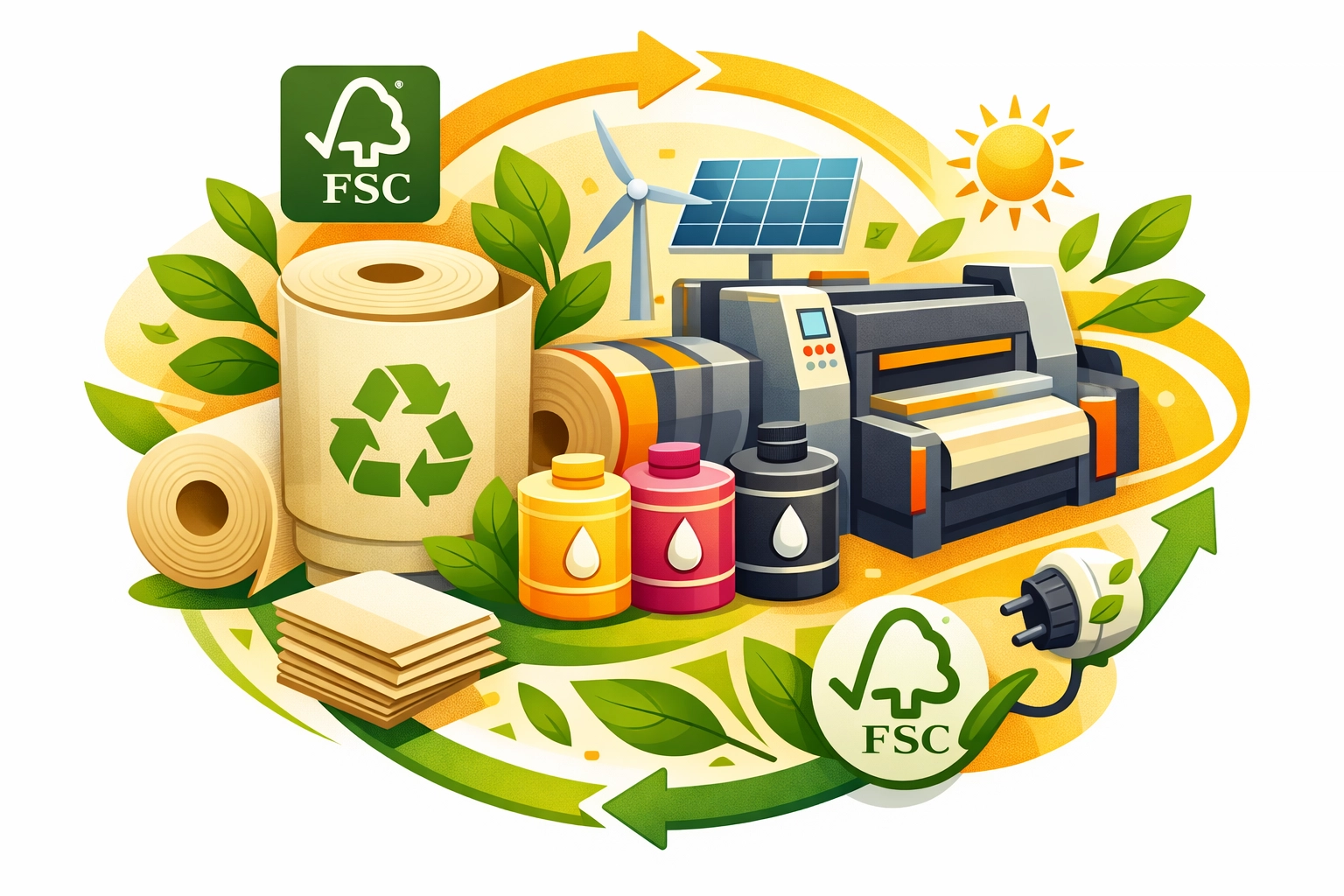
Smart agencies invest systematically in sustainability infrastructure: recycled and FSC-certified paper stocks, vegetable-based and low-VOC inks, energy-efficient press technology, and on-demand printing models that minimize waste. These investments serve dual purposes. They meet customer requirements while reducing material costs and waste disposal expenses.
Sustainability also creates marketing differentiation. Agencies can quantify environmental benefits for clients: pounds of paper saved through shorter runs, reduced carbon emissions from local production, and waste diversion from landfills. These metrics matter to clients facing their own sustainability commitments and stakeholder scrutiny.
Strategic Adaptation #4: Personalization and Variable Data Capabilities
Variable data printing (VDP) has shifted from competitive advantage to customer expectation. Direct mail campaigns with personalized images, text, and offers generate measurably higher response rates than generic communications. Agencies offering sophisticated data-driven print solutions position themselves at the forefront of marketing effectiveness conversations rather than transactional production discussions.
The technology infrastructure supporting VDP extends beyond printing hardware. It requires database integration, design automation software, and quality control systems that verify accurate personalization across thousands of unique pieces. Agencies that build this capability can charge premium pricing because they deliver measurable marketing results rather than commodity print services.
Strategic Adaptation #5: AI-Powered Intelligence
Artificial intelligence is penetrating print production workflows in practical applications. Smart presses with predictive maintenance algorithms minimize unplanned downtime by identifying potential equipment failures before they occur. AI-powered color management systems maintain consistency across different substrates and production environments.
Workflow automation powered by machine learning reduces manual job setup, estimates production times more accurately, and optimizes press scheduling to maximize equipment utilization. These systems learn from historical data to improve performance continuously.
The agencies adopting AI capabilities gain cost advantages that compound over time. They reduce labor requirements for repetitive tasks, minimize material waste through optimized production planning, and improve delivery reliability through better capacity planning.
The Path Forward Requires Strategic Clarity
Traditional print production methods are not dead, but their relevance continues to contract to specialized niches. The mainstream print market has moved decisively toward digital technologies, automation, and data-driven production models that deliver speed, flexibility, and cost efficiency that traditional methods cannot match at comparable scale.
Agencies thriving in this environment make deliberate strategic choices. They invest in digital production infrastructure, automate workflows, build sustainability credentials, develop personalization capabilities, and leverage AI where it creates tangible operational advantages. They recognize that the industry has fundamentally transformed and position themselves accordingly.
The agencies struggling are those treating digital as supplementary to traditional production or hoping market demand for offset printing will stabilize. The data suggests otherwise. The strategic question is not whether to adapt, but how quickly and comprehensively to execute that adaptation.
Works Cited
AIGA. (2023). Sustainability in design practice: Industry trends and client expectations. AIGA Design Business & Ethics Series. https://www.aiga.org/resources/sustainability-practice
Keypoint Intelligence. (2024). Production inkjet adoption trends and profitability metrics. InfoTrends Commercial Print Forecast.
Print Magazine. (2023). The enduring appeal of traditional printing techniques. Print Magazine, 77(4), 34-39.
PRINTING United Alliance. (2024). Global print market forecast: Digital transformation and industry projections 2025-2035. PRINTING United Alliance Research Report.
Recent Comments