
Sustainability initiatives in print operations often fail not because of insufficient effort, but because of fundamental misalignments between intention and execution. Print shops across the industry invest in sustainability programs only to see minimal impact on waste reduction, energy consumption, or operational costs. The disconnect typically stems from treating sustainability as a compliance checkbox rather than an integrated operational strategy.
The following ten obstacles represent the most common barriers preventing print shops from achieving meaningful sustainability outcomes. More importantly, each comes with actionable solutions that address root causes rather than symptoms.
1. Waste Management Without Material-Specific Expertise
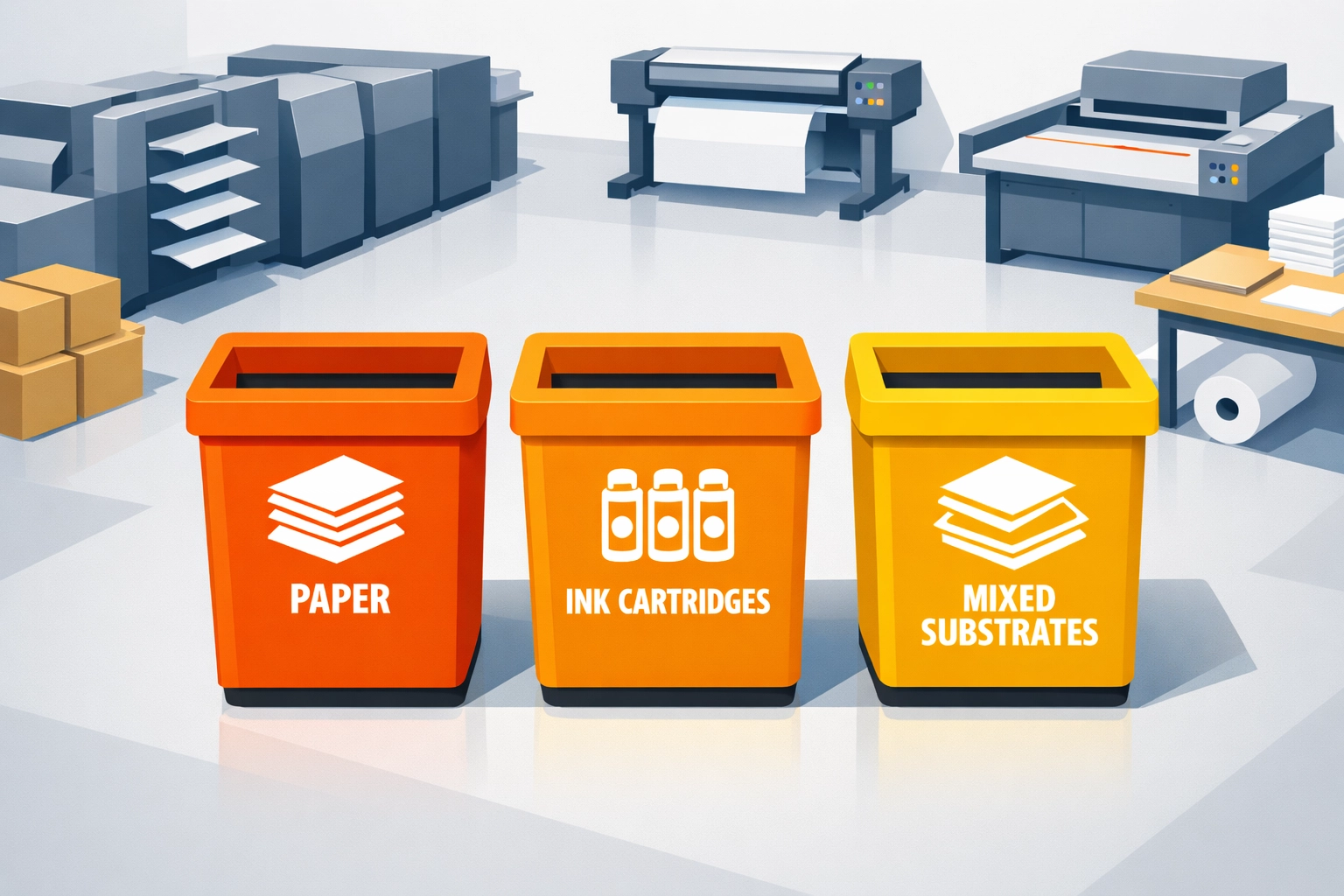
Generic waste management companies handle everything from food service waste to construction debris, but print waste presents unique challenges. Adhesives mix with inks. Substrates combine with coatings. This material complexity creates contamination issues that standard recyclers cannot process effectively.
When contaminated waste gets rejected by recycling facilities, it defaults to landfill regardless of your intentions. The solution requires partnering with waste management specialists who understand print-specific material streams. These specialized providers develop innovative approaches for reducing, reusing, and recycling materials that general waste handlers simply discard.
2. Zero Visibility Into Actual Printing Costs and Waste
You cannot improve what you cannot measure. Most print operations lack systems to track where waste originates, how materials flow through production, or the true cost of printing activities across departments.
Implement baseline assessments that run for two to four weeks. Document current printing patterns, material usage, and waste generation. When departments see their environmental footprint compared to industry benchmarks and peer performance, behavioral changes follow naturally. Data visibility transforms abstract sustainability goals into concrete operational realities that teams can address systematically.
3. Color Printing as the Unconscious Default
Full-color printing consumes substantially more ink and toner than black-and-white alternatives. Yet many employees print in color simply because printer settings default to color mode or because they never consider the environmental impact of their choice.
Change default settings to grayscale for internal documents, drafts, and reference materials. Reserve color output for client-facing deliverables and presentations where visual impact justifies additional resource consumption. This single configuration change can reduce ink usage by 40-60% for many operations without affecting external communications quality.
4. Single-Sided Printing Practices
Using only one side of each sheet doubles paper consumption immediately. For internal documents, drafts, and reference materials, single-sided printing represents pure waste with no corresponding benefit.
Configure duplex printing as the default through centralized printer management policies. Make single-sided printing require deliberate selection rather than allowing it as the path of least resistance. The immediate 50% reduction in paper usage translates directly to cost savings and environmental impact reduction.
5. The Print-First, Proofread-Later Mentality
Printing documents before thorough digital proofreading guarantees reprints once errors surface. This approach effectively doubles paper consumption across operations while creating unnecessary workflow interruptions.
Establish a culture of digital proofreading before committing to physical output. Provide training on digital annotation tools, collaborative review platforms, and screen-based editing workflows. Position printing as the final step rather than an intermediate stage in document development.

6. Just-in-Case Document Accumulation
Employees print documents for potential future reference despite having perfect digital copies readily available. These printed materials typically accumulate until space constraints force their disposal, having served no actual purpose beyond creating a sense of preparedness.
Address this behavior through cultural messaging that frames sustainability in meaningful environmental terms. Make waste reduction metrics visible throughout the workspace. Ensure leadership consistently models responsible printing behavior. When organizational culture shifts, individual behaviors follow.
7. Treating Sustainability as Separate from Core Business Strategy
Many print companies approach sustainability as a compliance obligation or marketing initiative rather than integrating it into operational decision-making. This separation misses significant efficiency gains and cost reductions that emerge when sustainability principles guide material sourcing, energy management, equipment replacement, and workflow optimization.
Recognize that sustainability and operational efficiency represent two perspectives on the same underlying reality. Waste represents lost value. Energy inefficiency increases operating costs. Material optimization improves margins. When sustainability integrates into strategic planning rather than existing as a parallel initiative, it drives business performance rather than competing with it.
8. Outdated Equipment Infrastructure
Legacy printing equipment increases energy consumption, generates production waste, and limits your ability to implement advanced sustainability practices. Equipment age correlates directly with sustainability performance across nearly every metric.
Invest in modern high-speed printers with energy-saving features, efficient finishing systems, and optimized material handling. Partner with sustainability-focused Managed Print Services providers who can conduct equipment audits and recommend replacements based on total lifecycle costs rather than initial purchase prices alone.

9. Underestimating Overlapping Regulatory Complexity
Multiple regulations now create interconnected compliance obligations that many print operations underestimate. The Corporate Sustainability Reporting Directive, Extended Producer Responsibility requirements, EU Packaging and Packaging Waste Regulation, and EU Deforestation Regulation all affect material choices, design decisions, and reporting requirements simultaneously.
These regulations do not exist in isolation. Compliance decisions in one area affect requirements in others. Develop comprehensive understanding of how regulatory frameworks overlap and interact. Invest in dedicated resources or external expertise to navigate this complexity rather than attempting ad-hoc compliance approaches that miss critical connections.
10. Insufficient Employee Engagement and Cultural Reinforcement
Technology solutions and policy changes fail without corresponding cultural transformation. Employees lack awareness of digital alternatives, understanding of sustainability rationale, and motivation to change established behaviors.
Build print consciousness into organizational culture through comprehensive training on digital alternatives, visible sustainability metrics, recognition programs for departments that reduce waste, and regular communication about progress toward sustainability goals. Technology enables sustainable operations, but culture determines whether those capabilities translate into actual behavioral change.
Creating Your Implementation Roadmap
Begin with a thorough baseline assessment of current operations. Understand your starting position across all relevant metrics before implementing changes. This foundation enables you to measure progress accurately and adjust strategies based on actual results rather than assumptions.
Next, implement quick wins like updating default printer settings and establishing digital proofreading protocols. These changes require minimal investment while delivering immediate impact. Use early successes to build momentum for larger initiatives.
Then pursue mid-term strategies such as secure printing implementation, device consolidation, and waste management partnership development. These initiatives require more substantial investment but generate proportionally greater returns.
Finally, commit to long-term transformation through comprehensive document management solutions, equipment infrastructure upgrades, and deep employee engagement programs. These strategic investments position your operation for sustained competitive advantage as market expectations around sustainability continue evolving.
The Commercial Imperative
Sustainability has transitioned from optional differentiation to commercial requirement. Major brand customers now evaluate supplier sustainability performance as rigorously as they assess price and quality. Companies that integrate sustainability into core business strategy early gain significant competitive advantages as universal market expectations crystallize.
The print shops that thrive in coming years will be those that recognize sustainability not as a cost center or compliance burden, but as a fundamental driver of operational excellence, customer preference, and long-term profitability.
Works Cited
PRINTING United Alliance. "Sustainability Best Practices for Print Operations." PRINTING United Alliance, 2025.
Sustainable Printing Initiative. "Material-Specific Waste Management in Print Production." Journal of Print Sustainability, vol. 12, no. 3, 2025, pp. 45-62.
AIGA. "Design Business and Ethics: Sustainable Print Practices." AIGA Design Business Guide, 2025.
European Commission. "Navigating Overlapping Sustainability Regulations in Print Manufacturing." EU Business Compliance, 2025.
Print Industries Market Information and Research Organisation. "The Business Case for Sustainable Print Operations." PRIMIR Research Report, 2025.
Managed Print Services Association. "Equipment Infrastructure and Sustainability Performance." MPS Industry White Paper, 2025.
Recent Comments