
The print industry has reached an inflection point. Expansion no longer means simply purchasing larger equipment or hiring additional staff. In 2026, scalability depends on strategic technology integration, workflow automation, and operational agility. Print shops that expand production capacity without understanding these fundamental shifts risk overextending financially while falling behind competitors who prioritize efficiency over square footage.
This guide outlines ten critical considerations before committing capital to expansion. Whether you operate a commercial print shop, screen printing business, or specialty decoration service, these insights will help you make informed decisions that position your business for sustainable growth.
1. Software Integration Delivers Greater ROI Than Equipment Alone
The most profitable print shops in 2026 are not necessarily those with the newest presses. They are the ones that have connected their entire operation through unified software systems. Integration across sales portals, supplier networks, and production lines creates efficiency that new equipment alone cannot deliver.
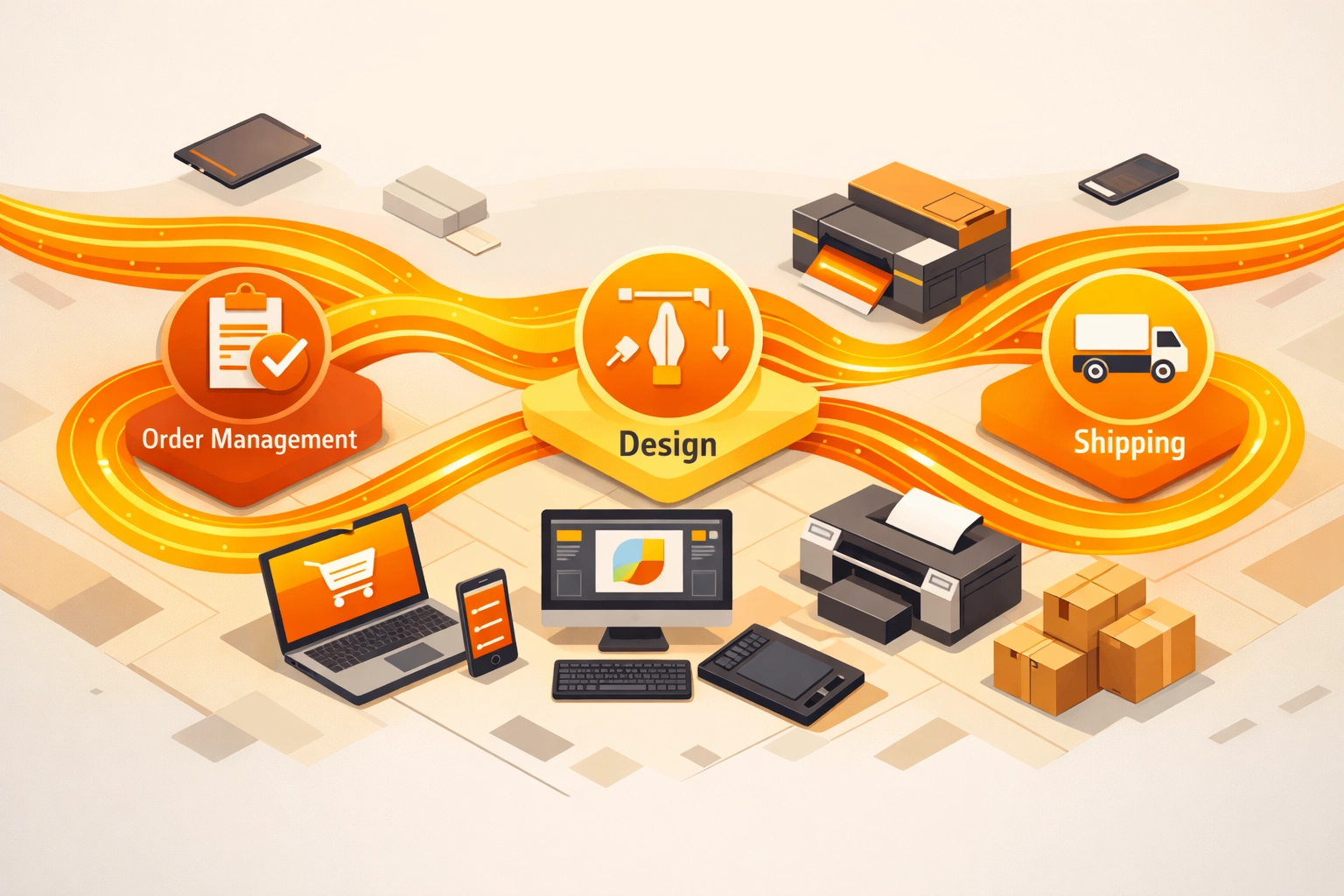
Real-time data flow from order intake through art approval, production scheduling, and shipping eliminates bottlenecks that typically slow operations. When your MIS (management information system) communicates seamlessly with your design software, production equipment, and fulfillment systems, you reduce manual touchpoints that cause errors and delays. Before investing in production capacity, audit your software infrastructure. The return on investment from proper integration often exceeds that of physical equipment purchases.
2. Automation Should Target Labor Dependency, Not Just Speed
Modern print technology has advanced to the point where automated systems rival traditional production speeds while requiring fewer operators. Direct-to-film (DTF) machines, for example, can now heat press 300 garments per hour at speeds comparable to screen printing setups that require significantly more labor input.
However, true automation extends beyond equipment specifications. Implement barcode or QR-driven workflows that automatically route jobs through your facility. Production tracking systems that update in real time reduce the need for manual status checks and allow staff to focus on quality control and customer service rather than job babysitting. Calculate labor cost reduction as carefully as you calculate throughput increases when evaluating expansion options.
3. Print-On-Demand Has Moved From Optional to Essential
Print-on-demand (POD) capabilities are no longer a niche offering. Successful print operations have scaled POD from representing 3,000 units annually to comprising 32% of total output, with some facilities handling 6,000 POD units daily during peak periods.
The business case for POD extends beyond convenience. It reduces material waste by eliminating speculative inventory, cuts storage costs, and allows you to fulfill orders in the exact quantities customers need. As retailers and brands increasingly demand just-in-time production, POD infrastructure provides a competitive advantage that traditional bulk printing cannot match. Any expansion plan should allocate resources to POD capabilities proportionate to their growing market share.

4. Capital Investment Requires Sustained Commitment Beyond Initial Purchase
Equipment salespeople emphasize acquisition costs, but scalability demands sustained financial commitment. Staying competitive in 2026 requires continuous investment in software updates, maintenance contracts, operator training, and periodic equipment upgrades, often on shorter timelines than business owners prefer.
Budget for technology refreshes every three to five years rather than expecting equipment to remain competitive for a decade. Factor in ongoing costs for software licensing, cloud-based management tools, and cybersecurity as integral to expansion rather than optional add-ons. Print shops that plan for sustained investment outperform those that treat expansion as a one-time capital expenditure.
5. Wide Format Printing Opens Adjacent Revenue Streams
Wide format capabilities represent one of the clearest paths to scalable growth because they unlock entirely new application categories without abandoning existing operations. Wall graphics, window displays, fleet graphics, retail signage, and event backdrops all carry higher profit margins than traditional printing while appealing to different customer segments.
The beauty of wide format expansion lies in its complementary nature. Existing design and customer service infrastructure supports the new capabilities without proportional overhead increases. A single wide format printer can diversify revenue streams and increase average order values significantly. Evaluate wide format not as a replacement for current operations but as a strategic addition that leverages existing business relationships.
6. Hybrid Decoration Techniques Lower MOQs and Expand Market Reach
Customer expectations have shifted decisively toward customization with lower minimum order quantities. Hybrid decoration techniques meet this demand by combining technologies in creative ways. Embroidered emblems on DTF-printed garments, for instance, provide premium decoration at order quantities previously impossible with traditional screen printing and embroidery requirements.
Small and mid-sized decorators can now compete for business that once required significant setup costs and minimums. Even without owning every technology in-house, you can access on-demand embellishments through fulfillment partnerships. Scalability in 2026 means flexibility to serve customers at various order sizes and complexity levels, not just higher volume capacity.

7. Web-to-Print and Ecommerce Integration Reduce Friction
Custom web-to-print platforms have evolved from convenience features to competitive necessities. These systems allow customers to design products, submit orders, and track production status without requiring staff intervention for routine transactions. When properly integrated with ERP, CRM, and inventory management systems, web-to-print reduces manual data entry, accelerates order processing, and improves accuracy.
The scalability advantage becomes clear during growth phases. Your order volume can increase substantially without proportional increases in customer service staff. Automated order intake, payment processing, and production routing create capacity for growth that manual systems cannot match. Prioritize ecommerce infrastructure that synchronizes with your production workflow rather than treating it as a separate system.
8. Strategic Outsourcing Expands Capacity Without Capital Investment
Not every expansion requires equipment purchases. Small and mid-sized decorators increasingly scale through certified partner networks and brand-on-demand programs. By becoming fulfillment partners for national brands or collaborating with complementary shops, you can accept larger orders and broader product ranges without the capital investment that purchasing equipment demands.
This approach proves particularly valuable when exploring new decoration methods or product categories. Test market demand through partnerships before committing to equipment purchases. Some of the fastest-growing print operations maintain lean physical footprints while expanding market reach through strategic networks. Evaluate every expansion decision by asking whether partnership models could deliver similar results with less risk.
9. Nearshore Production Advantage Creates New Opportunities
The supply chain disruptions of recent years have fundamentally altered sourcing strategies. Retailers and distributors are actively rebalancing from 100% overseas manufacturing toward 80/20 domestic/overseas models. This shift creates substantial opportunities for print shops offering fast turnaround and locally-produced items.
Connected POD infrastructure gives you competitive advantages in this environment. Brands seeking to reduce waste, shorten lead times, and respond quickly to market trends will increasingly favor domestic partners who can deliver on-demand production. Position your expansion to capture this nearshore opportunity rather than competing solely on price with overseas producers. Speed, customization, and communication often outweigh marginal cost advantages for time-sensitive projects.

10. Sustainability and Personalization Are Market Requirements, Not Differentiators
Modern customers expect both sustainable practices and personalized products as baseline offerings rather than premium features. Made-on-demand production addresses both expectations simultaneously by reducing waste while enabling customization at scale.
Print shops that position expansion around these capabilities align with long-term market trends rather than fighting them. Water-based inks, energy-efficient equipment, waste reduction programs, and local production all resonate with environmentally conscious customers while improving operational efficiency. Similarly, the ability to personalize products economically at low quantities has moved from niche offering to standard expectation. Build expansion plans that treat sustainability and personalization as foundational rather than optional.
The Path Forward
Scalability in 2026 fundamentally differs from traditional expansion models. Physical production capacity matters less than operational efficiency, technology integration, and market responsiveness. Print shops that prioritize software infrastructure, automation, and strategic flexibility will outperform competitors who simply add equipment and square footage.
Before committing to expansion, conduct an honest assessment of your current technology stack, workflow efficiency, and market positioning. Often, the highest-return investments involve optimizing existing operations through better integration before adding capacity. When you do expand, ensure that new capabilities align with market trends toward personalization, sustainability, fast turnaround, and low minimum orders.
The print industry remains robust and growing, but the definition of competitive advantage has evolved. Success belongs to operations that combine production capability with technological sophistication and market agility. Plan your expansion accordingly.
Works Cited
"2024 State of the Industry Report." PRINTING United Alliance, 2024. https://www.printing.org/research
Auer, Gerard. "Wide Format Printing: Growth Opportunities for Commercial Printers." SGIA Journal, vol. 45, no. 2, 2023, pp. 12-18.
"Automation and Integration in Print Production." American Institute of Graphic Arts, 2025. https://www.aiga.org
Chambers, Robert. "Print-On-Demand Market Analysis 2026." Print Professional, vol. 38, no. 1, 2026, pp. 24-31.
"Digital Decoration Technology Trends." Specialty Graphic Imaging Association, 2025. https://www.sgia.org/research
Miller, Susan K. "Web-to-Print Solutions for Production Scalability." Graphics of the Americas Conference Proceedings, 2025, pp. 156-163.
Recent Comments