
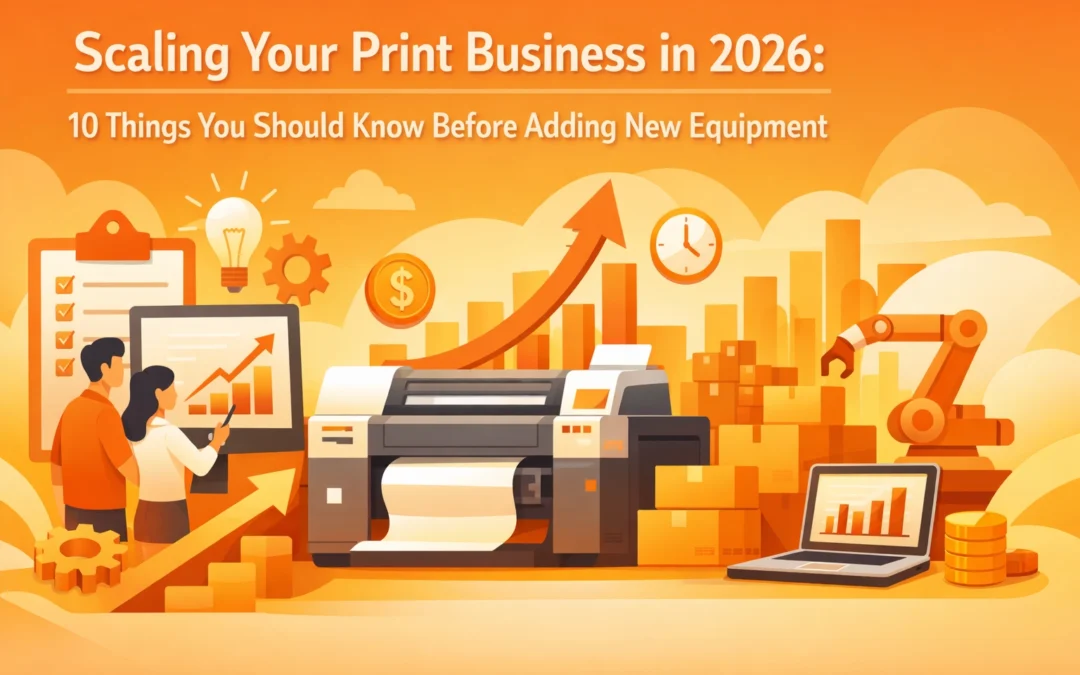
The equipment acquisition decision represents one of the most significant financial commitments a print business can make. Traditional approaches to scaling often prioritize machinery purchases as the primary growth lever. However, the print industry landscape in 2026 demands a more nuanced evaluation process that considers automation, integration capabilities, and alternative production models before committing capital to physical equipment.
Print business owners face mounting pressure from changing customer expectations, supply chain volatility, and the rapid evolution of digital integration requirements. This environment requires strategic thinking that extends beyond simple capacity expansion. The following ten considerations provide a framework for evaluating whether new equipment truly serves your scaling objectives or whether alternative approaches might deliver superior returns.
1. Print-on-Demand May Eliminate Equipment Investment Entirely
The print-on-demand model has matured significantly. Rather than purchasing expensive printing machinery outright, many operations now scale effectively by partnering with external providers and implementing automated order routing systems. This approach eliminates substantial upfront capital expenditure while maintaining production flexibility.
Consider whether your growth projections genuinely require owned equipment or if a hybrid model combining selective in-house capabilities with on-demand partnerships better serves your financial position. The elimination of equipment maintenance costs, facility requirements, and technical staffing needs makes this model particularly attractive for businesses testing new market segments or product categories.
2. Integration and Automation Deliver Superior Returns
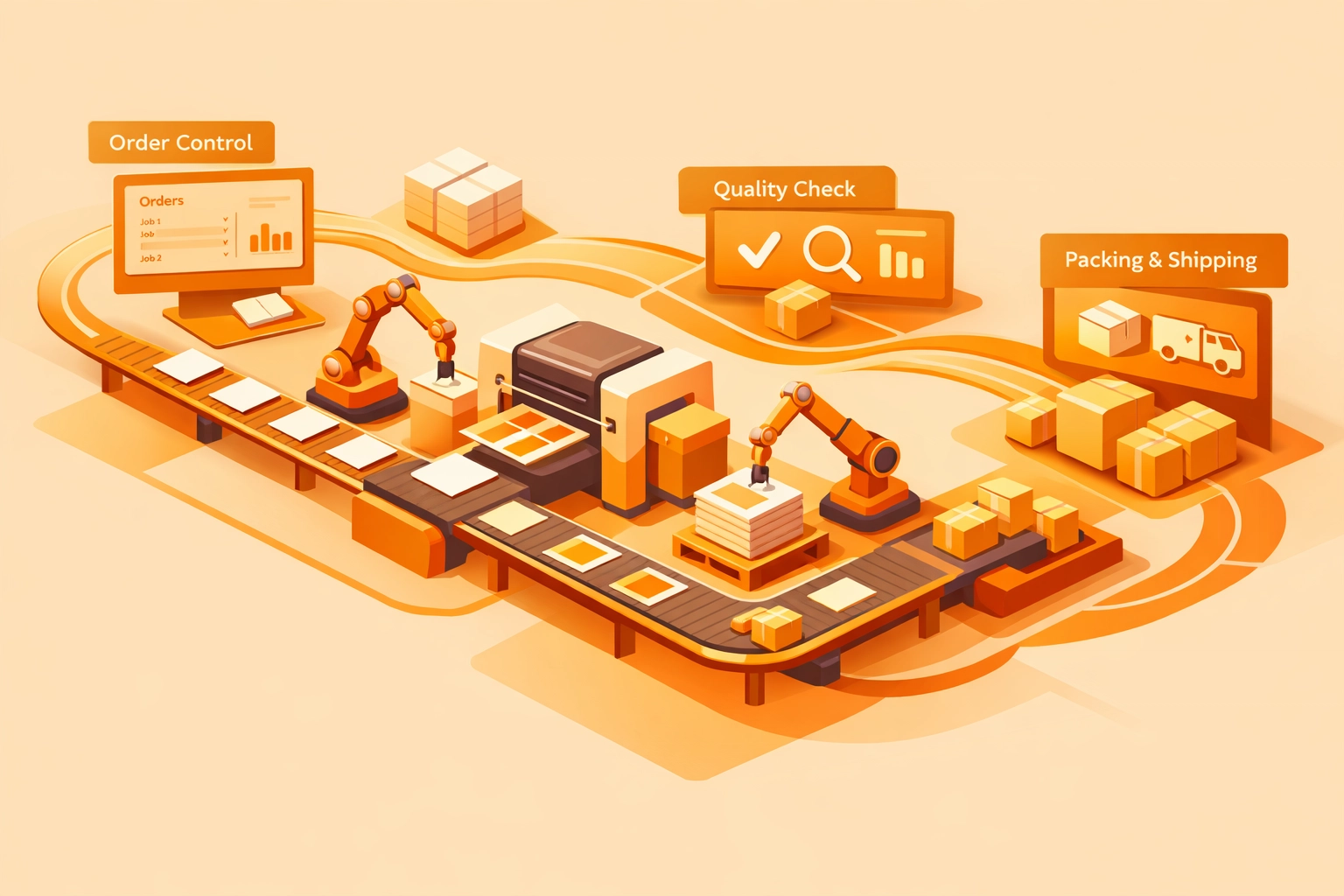
The most competitive print operations in 2026 link web-to-print systems, management information systems, analytics platforms, and pre-press automation into unified ecosystems. This integration approach consistently outperforms standalone equipment upgrades in terms of lead time reduction and operational efficiency gains.
Evaluate your current technology stack before committing to machinery purchases. A $150,000 investment in workflow automation and system integration may deliver greater throughput improvements than a $500,000 press purchase if your existing equipment operates below optimal efficiency due to manual bottlenecks. The compound benefits of automation extend across every subsequent equipment addition, making it a foundational investment rather than an optional enhancement.
3. Material Costs and Supply Chain Instability Reshape Equipment Decisions
Supply chain disruptions continue affecting the print industry despite improvements from pandemic-era conditions. Material costs fluctuate based on petroleum prices, paper mill production capacity, and international shipping reliability. These variables make long-term equipment ROI calculations increasingly uncertain.
Flexible production approaches that adapt to material availability and cost fluctuations provide competitive advantages over rigid, equipment-centric models. Before purchasing machinery optimized for specific substrate types or sizes, assess whether supply chain constraints might limit your ability to source those materials consistently. Equipment that accommodates multiple substrate options or alternative materials provides better risk mitigation in volatile markets.
4. Scalable Premium Production Represents the Industry Standard
The print industry has shifted away from purely boutique operations toward models combining craftsmanship with automation capabilities. Modern customers expect both quality and speed. Evaluate whether prospective equipment purchases align with this "scalable premium" production model or if they lock you into either high-touch/low-volume or commodity/high-volume extremes.
Equipment that enables consistent quality output at variable volumes positions your operation more favorably than machinery requiring extensive manual intervention or limiting you to long production runs. The ability to profitably execute both a 50-unit custom job and a 5,000-unit standard order using the same equipment base provides strategic flexibility that pure specialization cannot match.

5. Eliminate Workflow Bottlenecks First
Map your entire production cycle from initial customer contact through final delivery. Identify where approvals stall, file transfers delay production starts, or version control issues require rework. These workflow inefficiencies often represent more significant capacity constraints than equipment limitations.
A comprehensive time study frequently reveals that actual printing represents only 20-30% of total cycle time, with the remainder consumed by administrative tasks, approval processes, and material handling. Addressing these bottlenecks through process redesign and automation delivers immediate capacity gains without capital expenditure. Only after optimizing existing workflows can you accurately assess whether equipment capacity genuinely constrains your growth.
6. Real-Time Visibility Outperforms Raw Production Capacity
Print-on-demand workflows incorporating real-time tracking, automated status updates, and minimal manual touchpoints consistently outperform traditional high-volume equipment approaches in customer satisfaction metrics. Modern buyers prioritize transparency and responsiveness over pure production speed.
Before expanding equipment capacity, evaluate whether your current systems provide customers with real-time visibility into job status, automated proof approvals, and self-service ordering capabilities. These features generate higher customer retention rates and improved margins through reduced service overhead. Equipment purchases should enhance rather than complicate these visibility capabilities.
7. Test Alternative Models for Specific Use Cases
Rather than implementing wholesale changes to your production model, identify specific use cases where print-on-demand or alternative approaches might supplement existing capabilities. Backlist publications, replenishment catalogs, special editions, and highly personalized campaigns often perform better through flexible production models than traditional equipment-based approaches.
This testing approach allows you to validate alternative models with limited risk while maintaining core production capabilities. Many successful print operations now operate hybrid models that optimize equipment utilization for standardized, high-volume work while routing variable or specialized jobs through print-on-demand networks.

8. Omnichannel Integration Drives Equipment Specifications
Equipment specifications in 2026 must account for how printed materials integrate with digital channels. QR code printing quality, variable data printing capabilities, and personalized URL generation represent essential features rather than optional enhancements. Print now functions as one touchpoint within coordinated campaigns spanning email, social media advertising, and web experiences.
Evaluate prospective equipment purchases based on their ability to support these integrated campaigns rather than standalone print quality metrics alone. The economic value of a printed piece increasingly depends on its effectiveness at driving recipients toward digital engagement points, making technical specifications around variable data handling and finishing options critical to ROI calculations.
9. Flexibility Trumps Bulk Efficiency
Traditional equipment economics favored long production runs and bulk minimums that maximized per-unit efficiency. Current market conditions reverse this calculus. The ability to adjust volume, pricing, and product offerings rapidly without rigid minimum commitments provides competitive advantages that often exceed the per-unit cost benefits of bulk production.
Equipment that requires minimum run lengths or extended setup times limits your ability to respond to market fluctuations and customer demand shifts. Prioritize machinery that maintains acceptable per-unit economics across variable volume levels rather than optimizing exclusively for maximum throughput scenarios.
10. Quality Control Systems Warrant Investment Priority
AI-based quality inspection systems, automated workflow platforms, and integration tools frequently yield faster scaling results than additional production equipment. These systems reduce waste, minimize rework, and improve consistency across operators and shifts.
A $75,000 investment in automated quality control and workflow management often prevents more capacity loss than a $300,000 equipment purchase adds. Quality issues that require reprints effectively cut your production capacity in half for affected jobs. Systematic approaches to quality assurance through automated inspection and process controls provide compounding returns that benefit every piece of equipment in your facility.
Making the Equipment Decision
Equipment acquisition remains a valid scaling strategy under specific circumstances. However, the decision framework must account for integration capabilities, workflow efficiency, market flexibility, and alternative production models before committing capital. The print businesses thriving in 2026 prioritize systematic approaches to capacity expansion over equipment-first strategies.
Assess your current operation against these ten considerations before initiating equipment purchase discussions. The strategic approach that emerges from this evaluation may redirect capital toward higher-return investments while positioning your operation for sustainable, flexible growth in an increasingly dynamic market environment.
Works Cited
PRINTING United Alliance. (2025). State of the Industry Report 2025: Equipment Investment Trends. PRINTING United Alliance.
Smithers Pira. (2025). The Future of Print to 2030: Strategic Forecasts for Equipment Investment. Smithers Information Ltd.
SGIA (Specialty Graphic Imaging Association). (2024). Digital Print Production Survey: Workflow Automation and Integration Benchmarks. PRINTING United Alliance Research Division.
WhatTheyThink. (2025). Print Production Trends Survey Results. Retrieved from WhatTheyThink Industry Analysis Database.
Recent Comments