
Print shop profitability hinges on one critical metric: return on investment. While creative talent and client relationships drive revenue, equipment ROI determines whether your operation generates sustainable profit margins or burns through capital. Industry data reveals that strategic equipment management can deliver 20-30% annual cost savings, with most implementations achieving payback within 12-18 months.
Establishing Your ROI Baseline
The foundation of equipment profitability starts with accurate measurement. The standard ROI formula for print finishing equipment is straightforward: divide net profits by total cost of ownership, then multiply by 100 to get your ROI percentage. A $50,000 equipment investment generating $15,000 in additional annual profits yields a 30% ROI. Industry benchmarks consider any investment above 15% ROI favorable, though competitive operations typically target higher returns.
Total cost of ownership extends far beyond the purchase price. Calculate the complete financial picture by including maintenance contracts, consumables and supplies, replacement parts inventory, downtime costs, and labor expenses associated with operation and troubleshooting. This comprehensive approach prevents the common mistake of underestimating true equipment costs, which can erode profitability over multi-year ownership cycles.
Right-Sizing Your Print Infrastructure
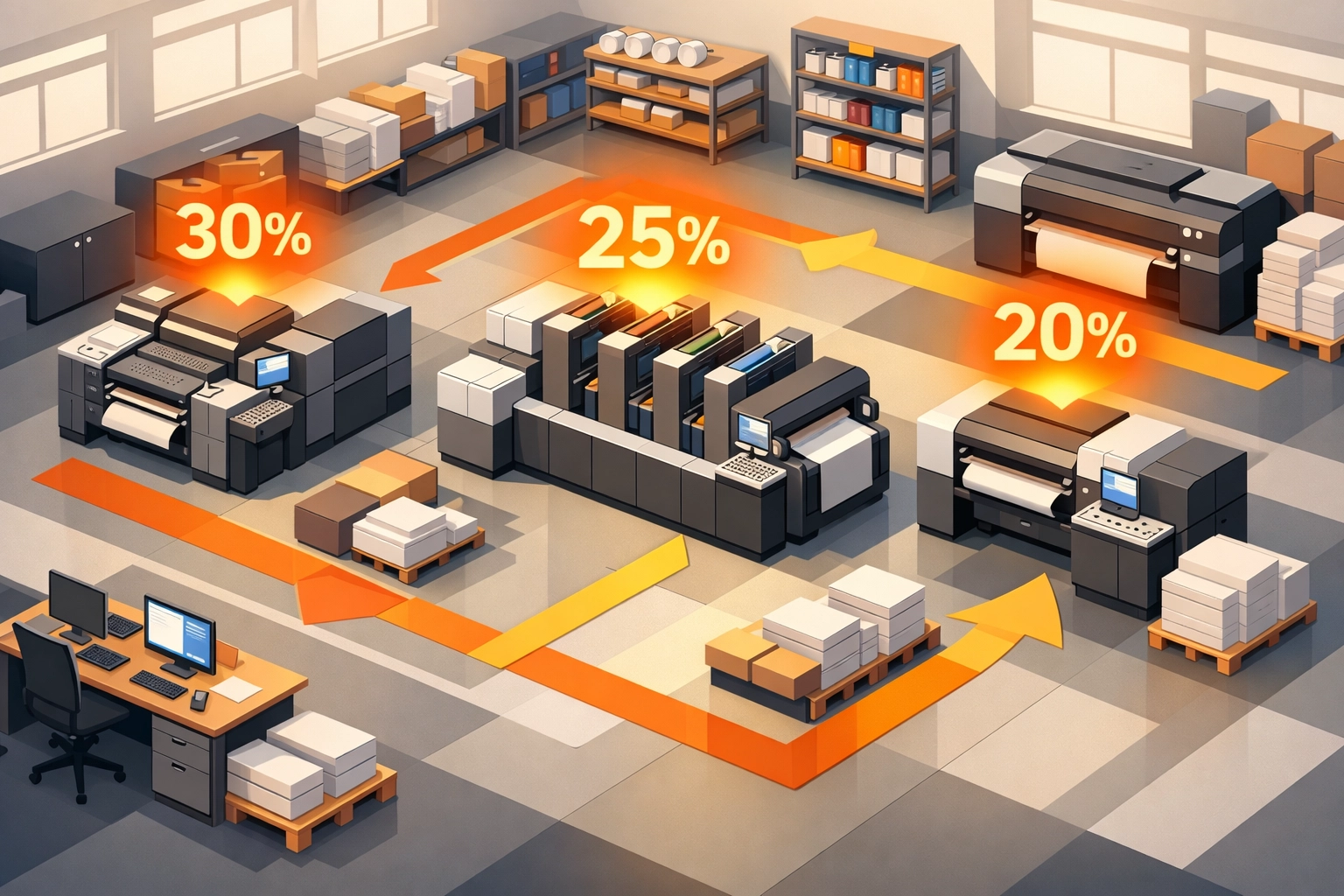
Fleet optimization begins with honest assessment of your current device utilization. Most print operations perform optimally with device-to-employee ratios between 10:1 and 15:1, though specific ratios vary based on production volume and workflow complexity. Evaluate your environment by examining device distribution patterns, actual capacity utilization versus potential output, equipment age and efficiency ratings, and physical placement relative to workflow patterns.
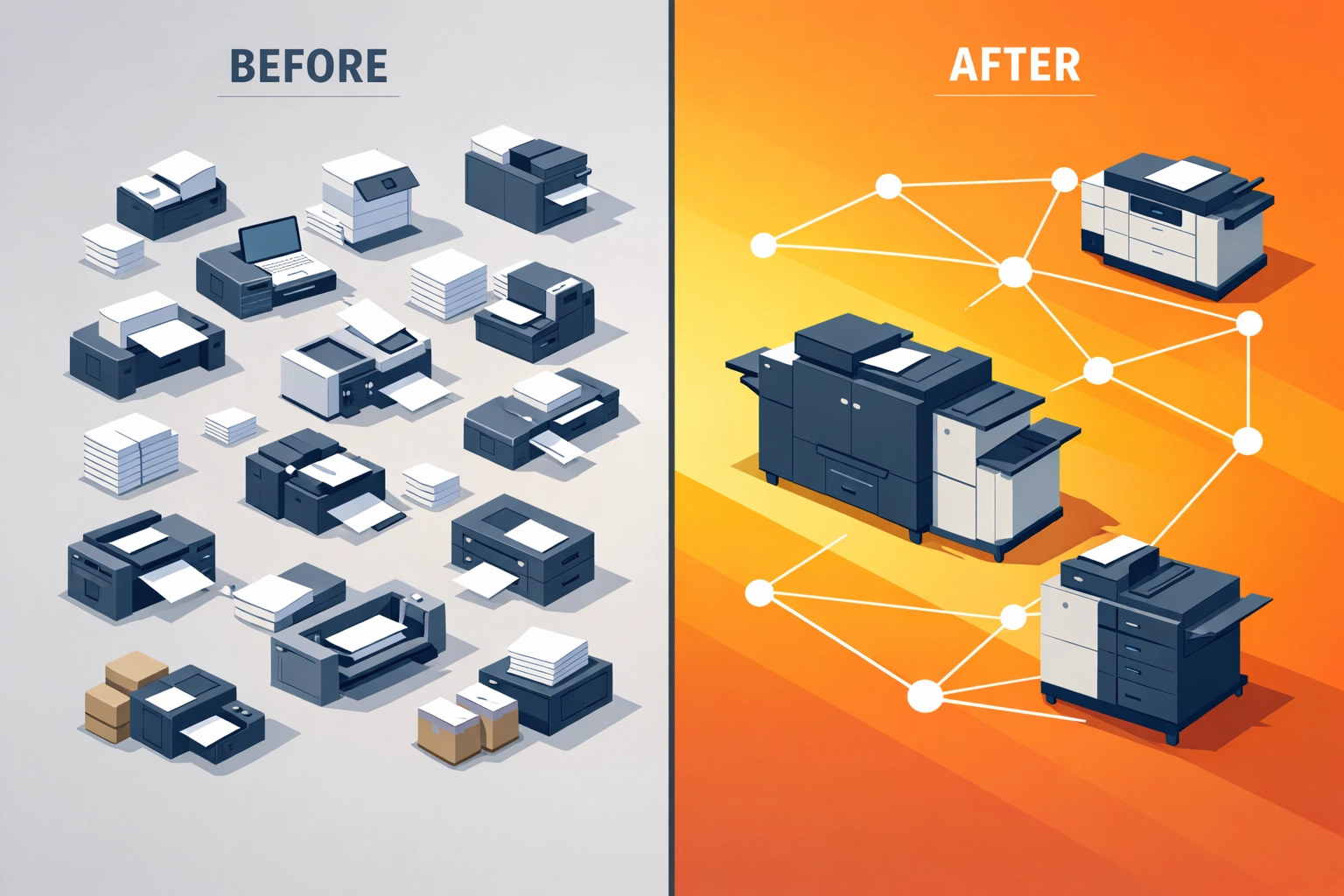
Strategic consolidation typically outperforms complete infrastructure overhauls. A Vermont manufacturing operation reduced their device count by 40% through targeted consolidation, achieving a 22% reduction in print-related expenses within twelve months. The key lies in phased implementation. Remove the most inefficient devices first, then introduce multifunction equipment in strategic locations where workflow analysis indicates maximum impact.
Leveraging Managed Print Services for Cost Reduction
Managed Print Services deliver average cost reductions of 15-25% across print operations. These specialized providers conduct comprehensive evaluations of printing infrastructure, identifying redundant equipment, underutilized devices, and optimization opportunities that internal teams often overlook. The business case for MPS adoption is compelling: 78% of organizations cite cost reduction as their primary adoption driver, and nearly 60% report measurable ROI within the first twelve months.
The value extends beyond simple cost cutting. MPS providers bring industry expertise, automated monitoring systems, and proactive maintenance protocols that reduce downtime and extend equipment lifecycles. They also implement standardized supplies management, reducing inventory costs while ensuring production continuity.
Data-Driven Optimization Strategies
Performance tracking transforms equipment management from reactive maintenance to strategic optimization. Establish clear key performance indicators including print volume trends, cost per page metrics, policy compliance rates, and overall cost savings against baseline measurements. These KPIs provide objective evidence of optimization effectiveness and identify emerging problems before they impact profitability.
Print management software enables granular usage monitoring across your entire fleet. Advanced platforms track individual job costs, enforce cost-saving policies like duplex printing defaults, and flag unnecessary print jobs that drain resources without business justification. Cloud-based solutions offer particular advantages through detailed cost reporting and real-time usage monitoring. This visibility reveals optimization opportunities that remain invisible in traditional print environments.
Consider implementing rule-based automation to enforce cost-saving behaviors. Automatically route color jobs to lower-cost monochrome devices when appropriate, set duplex printing as the default across all devices, and establish approval workflows for large print jobs. These automated controls reduce costs without requiring constant manual oversight.
Understanding Payback Timelines
Organizations typically experience two distinct payback scenarios. Quick wins requiring zero capital investment deliver immediate returns. Eliminating unused devices, enabling duplex defaults system-wide, and implementing basic print policies generate savings within weeks. These foundational changes establish momentum and demonstrate value to stakeholders.
Strategic consolidation involving device replacement requires longer payback periods of 18-24 months but produces larger cumulative savings across three-year equipment lifecycles. Gartner research documents that structured fleet optimization implementations achieve up to 30% reductions in total print-related expenses, with the majority of savings realized within the first year post-implementation.

Operational Best Practices for Maximum ROI
Infrastructure optimization provides the framework, but operational excellence sustains profitability over time. Regular preventive maintenance prevents costly emergency repairs and production downtime. Schedule maintenance during low-volume periods and maintain detailed service records to identify recurring issues that indicate equipment nearing end-of-life.
Strategic device placement significantly impacts productivity and costs. Position high-volume equipment near primary users to reduce travel time and encourage efficient job batching. Consolidate specialty finishing equipment in dedicated production areas where skilled operators can maximize throughput and quality.
Equipment selection requires matching capabilities to actual business requirements. Over-specified equipment with unnecessary features wastes capital and increases operating costs. If your shop rarely produces color work, investing in high-end color equipment drains resources without competitive advantage. Conversely, underspecified equipment creates production bottlenecks that limit revenue growth.
Encourage responsible usage through training and accountability. Operators who understand equipment capabilities and limitations produce better results with less waste. Implement tracking systems that assign costs to specific jobs or departments, creating financial visibility that naturally reduces unnecessary consumption.
Building Long-Term Profitability
Equipment ROI optimization is not a one-time project but an ongoing operational discipline. Market conditions shift, client requirements evolve, and technology advances create new efficiency opportunities. Successful print operations conduct quarterly reviews of equipment utilization, benchmark performance against industry standards, and maintain capital replacement plans aligned with business growth projections.
The print industry faces increasing pressure from digital alternatives and evolving client expectations. Operations that treat equipment as strategic assets rather than fixed costs position themselves for sustainable profitability regardless of market conditions. Data-driven decision making, strategic infrastructure optimization, and disciplined cost management separate profitable operations from those struggling to maintain margins.
Works Cited
Gartner Research Group. "Print Fleet Optimization: Cost Reduction Strategies and ROI Benchmarks." Gartner Industry Research, 2024.
"Maximizing ROI on Print Finishing Equipment." PRINTING United Alliance, 2025, www.printing.org/equipment-roi-guide.
"Managed Print Services: Adoption Trends and Business Impact Analysis." Print Industry Quarterly, vol. 42, no. 3, 2025, pp. 112-128.
O'Brien, Michael. "Strategic Print Infrastructure Management: A Guide to Fleet Optimization." Print Production Management Journal, vol. 18, no. 2, 2024, pp. 45-62.
Stevens, Rebecca, and James Liu. "Total Cost of Ownership in Commercial Print Operations." AIGA Business Insights, 2025, www.aiga.org/print-equipment-tco.
Recent Comments