
Print professionals face a persistent challenge in 2026: operating cost inflation continues to outpace pricing power. While industry benchmarks from PRINTING United Alliance suggest achievable gross margins averaging 31.5% of sales, the path to these numbers has grown increasingly complex. Understanding where your operation stands relative to these benchmarks, and more importantly, what separates top performers from average ones, determines whether your business thrives or merely survives in a margin-compressed environment.
The Performance Distribution Reality
The PRINTING United Alliance Key Financial Ratios Program reveals a critical insight that should reshape how print professionals think about their operations. More than half of participating companies exceed 30% gross margins, and notably, 20.8% surpass the 40% threshold. This favorably skewed distribution indicates that strong operational strategy and market positioning create substantial performance gaps within the industry.
The variance matters. If your operation sits below 30% gross margin while competitors operate above 40%, you are not competing on equal footing. You face constrained reinvestment capacity, reduced pricing flexibility, and diminished ability to weather market disruptions. The margin gap compounds over time, affecting equipment upgrades, talent acquisition, and market expansion capabilities.

Supporting metrics from top performers establish additional benchmarks worth monitoring. Payroll costs average 33% of sales across the industry, distributed symmetrically around this midpoint. Companies that manage selling expenses to 6% or less (achieved by 42.5% of participants) demonstrate disciplined go-to-market operations. EBITDA performance ranges dramatically from 9.7% to 15% of sales, with diversification strategy playing a determining role in this spread.
Cost Inflation Versus Pricing Power
The margin compression narrative centers on a straightforward mathematical problem. Operating cost inflation ranges from 4.4% to 4.9% annually, while price increases lag at 3.0% to 3.4%. This 1.4 to 1.9 percentage point gap erodes margins quarter after quarter. As of early 2024, only 29.4% of companies reported improving pre-tax profitability, while 40.8% experienced declines. Current industry sentiment shows 62% of print professionals anticipating further margin reductions through 2026.
Labor costs drive much of this pressure. Skilled press operators, prepress technicians, and production managers command higher wages in competitive markets. Material costs, while somewhat stabilized from 2023 peaks, remain elevated relative to historical norms. Facility costs, insurance, and regulatory compliance expenses continue their steady upward trajectory regardless of revenue performance.
Simply raising prices rarely solves this equation. Price increases that exceed market tolerance trigger customer defection to competitors or alternative production methods. The solution requires operational transformation rather than simple price adjustments.
Diversification as Margin Protection
Data from PRINTING United Alliance quantifies the diversification advantage with precision. Companies diversified across multiple printing segments achieve 32.9% gross profit margins compared to 29.5% for non-diversified firms. More striking, diversified operations generate EBITDA of 15% versus just 9.7% for specialized competitors.
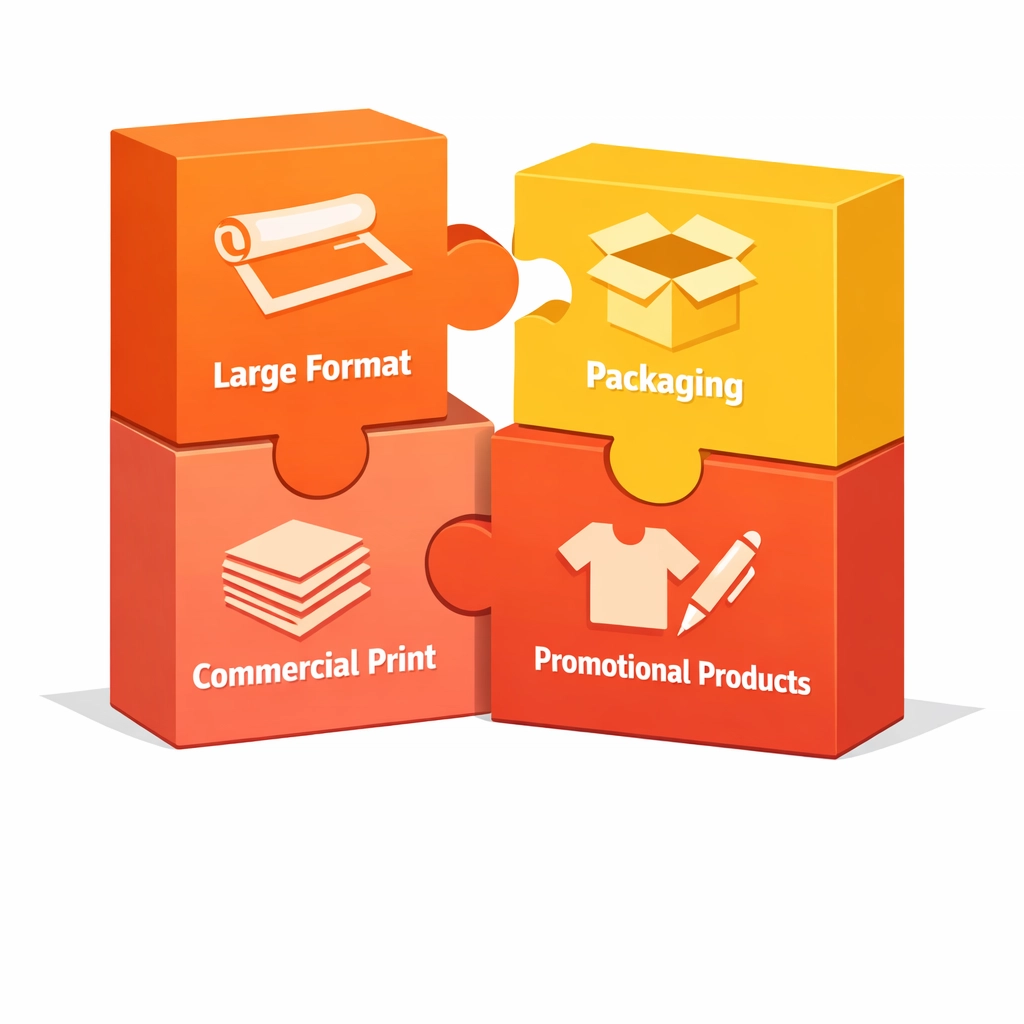
This performance gap stems from multiple factors. Diversified operations smooth demand volatility across different market segments, maintaining higher equipment utilization rates. They cross-sell complementary services to existing clients, reducing customer acquisition costs. Specialized expertise in multiple segments creates barriers to entry that protect pricing power. When one market segment contracts, diversified operations pivot capacity to stronger segments without the catastrophic utilization drops that devastate specialized shops.
Diversification strategy requires careful execution. Adding capabilities that share production infrastructure and expertise creates synergies. Adding unrelated services that require entirely new equipment, skills, and market relationships dilutes focus and strains management capacity. The strongest performers diversify strategically within their core competencies rather than pursuing scattered opportunities.
Automation Investment as Competitive Necessity
Seventy-seven percent of print providers now automate workflows, with 64% actively re-tooling operations to increase automation levels. This investment trend reflects a fundamental shift in how competitive operations maintain margins. Automation addresses labor cost inflation directly by reducing touch points, minimizing errors, and increasing throughput per labor hour.
The automation spectrum ranges from basic workflow software to fully integrated management information systems connecting estimating, scheduling, production, and accounting. Digital front ends that automate file preparation and preflight checking eliminate costly rework. Automated material handling systems reduce manual labor in loading, unloading, and material staging. Inline finishing equipment integrated with press operations reduces labor-intensive offline processes.

Return on automation investment varies significantly based on volume levels and labor rates. High-volume operations in high-cost labor markets achieve payback periods measured in months rather than years. Lower-volume shops require more selective automation investments focused on the highest-impact bottlenecks. The critical principle remains constant: labor cost inflation makes manual operations progressively less competitive regardless of skill levels.
Client Selection and Value Positioning
High-performing print operations make deliberate choices about which clients and projects to pursue. They focus on capturing high-quality revenue through selective client relationships rather than competing for every available job. This strategic discipline creates margin-friendly revenue compositions that sustain profitability despite market pressures.
Quality revenue exhibits specific characteristics. Clients value expertise and reliability over lowest price. Projects require capabilities that limit competitive alternatives. Relationships generate recurring work that reduces sales costs and improves production planning. Order values justify the full cost of sales, production, and service delivery with adequate margin contribution.
Conversely, low-quality revenue drains resources without adequate return. Price-driven buyers switch suppliers based on marginal cost differences. One-time projects require full sales effort without relationship value. Commoditized work attracts intense competition that drives margins to unsustainable levels. The discipline to decline low-quality opportunities separates top performers from struggling competitors.
Digital Capabilities and Customer Relationships
Implementing customized web portals and ecommerce platforms strengthens customer relationships according to 88% of providers who have deployed these capabilities. Equally important, 75% report increased order volume through digital ordering systems. These platforms create switching costs that protect customer relationships while reducing order processing costs.
Digital capabilities extend beyond simple online ordering. Automated reordering of repeat jobs reduces friction and captures routine business automatically. Template-based customization systems enable customers to modify standard products without design assistance. Digital asset management and brand compliance tools add value for corporate clients managing distributed marketing operations.
The competitive implication extends beyond convenience. Digital platforms generate data about customer behavior, preferences, and buying patterns. This intelligence enables proactive account management and targeted new product introduction. Competitors without equivalent digital capabilities compete at an information disadvantage in understanding and serving customer needs.
Strategic Imperatives for Margin Management
Print professionals seeking to achieve or exceed industry benchmark margins should prioritize several strategic initiatives. First, benchmark your current performance against PRINTING United Alliance ratios to identify specific gaps. If gross margins fall below 30%, investigate whether pricing, production efficiency, or material costs drive the shortfall.
Second, evaluate diversification opportunities within your operational capabilities and market relationships. Adding complementary services to existing clients often provides the highest-return diversification path. Third, audit workflows to identify automation opportunities with measurable return on investment. Focus initial automation investments on repetitive, high-volume processes where labor reduction benefits compound quickly.
Fourth, analyze customer profitability to identify high-quality versus low-quality revenue. Consider deliberately exiting low-margin relationships that consume disproportionate resources. Finally, assess digital capabilities relative to customer expectations and competitive offerings. Digital transformation often provides the foundation for both operational efficiency and customer retention.
The margin environment for print professionals will likely remain challenging through 2026 and beyond. Cost inflation shows no signs of reverting to historical norms, and pricing power remains constrained in most market segments. Operations that achieve benchmark performance separate themselves through strategic positioning, operational excellence, and disciplined capital allocation rather than hoping for market conditions to improve.
Works Cited
PRINTING United Alliance. "Key Financial Ratios Program: Industry Benchmark Report." PRINTING United Alliance, 2024.
PRINTING United Alliance. "State of the Industry Report: Operational Trends and Financial Performance." PRINTING United Alliance, 2024.
Printing Industries of America. "Economic Outlook and Market Trends." PIA, 2024.
Recent Comments