
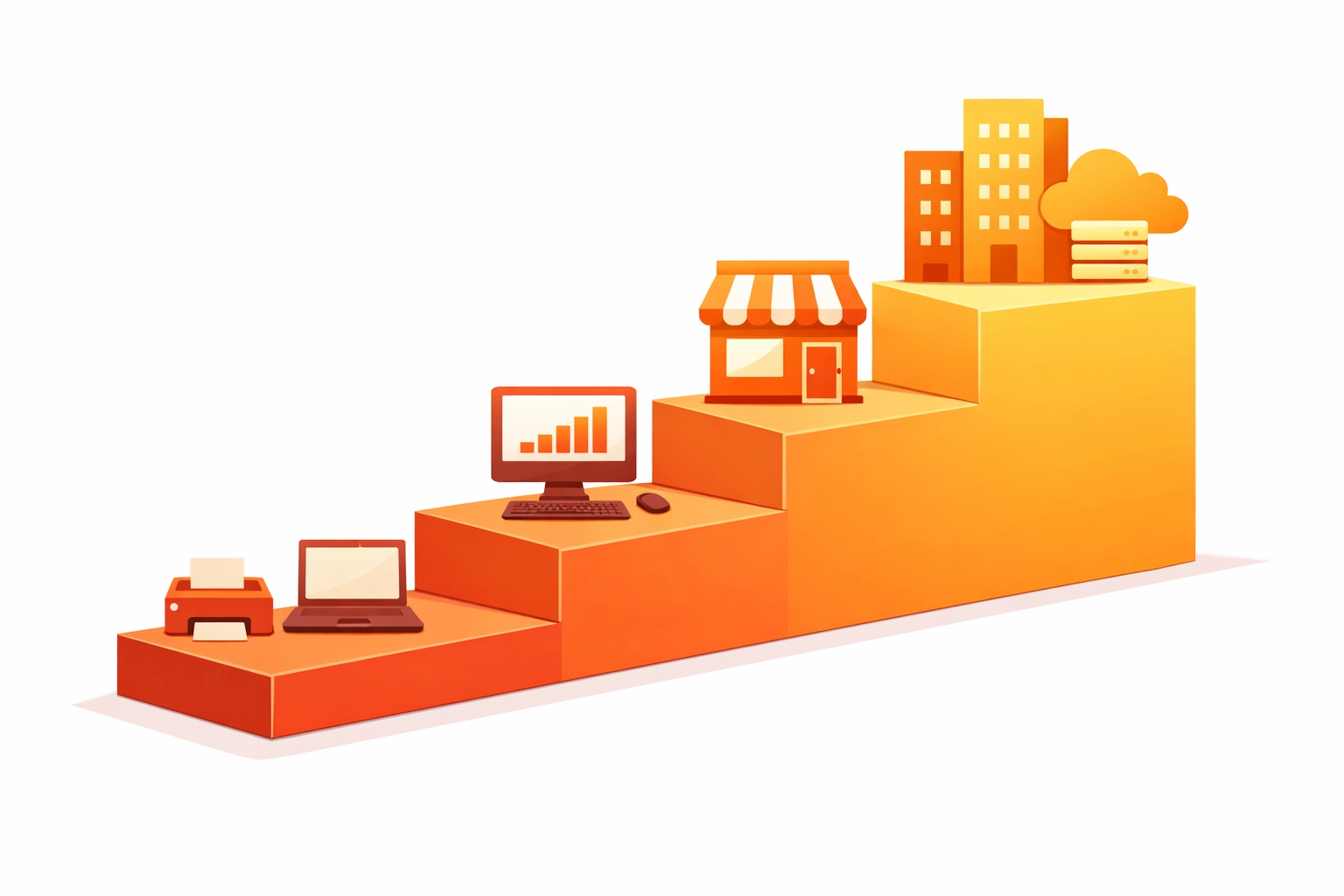
Scaling a print and creative services business demands more than ambition and technical skill. It requires precise financial planning and strategic capital allocation across multiple operational dimensions. The gap between a home-based print-on-demand operation and a full-service creative marketplace can span from $8,100 to over $459,000 in startup capital, making cost analysis a critical competency for business leaders in this sector.
Understanding where capital flows, which investments deliver returns, and how to structure expenditures for sustainable growth separates successful multi-service creative businesses from those that struggle to reach profitability. This analysis provides strategic insights into startup cost structures for print and creative service operations planning to scale beyond single-service offerings.
Capital Requirements Across Business Models
The financial foundation of your operation depends fundamentally on your chosen business model. Home-based print-on-demand businesses typically require approximately $8,100 in initial capital, covering basic equipment, initial inventory, and digital infrastructure. Full-service printing shops operate at a different scale entirely, with startup costs ranging from $20,150 to $32,200 for comprehensive service offerings.
Enterprise-scale marketplace platforms represent the upper tier of capital requirements. These operations need minimum cash reserves of $459,000 to reach break-even, reflecting the complexity of building technology infrastructure, hiring specialized teams, and funding customer acquisition at scale. The variance isn't simply about business size. It reflects fundamental differences in operational complexity, technology dependencies, and market positioning strategies.
Technology Infrastructure Investment
Platform and software development constitute the largest technology expense category for scaled operations. For marketplace platforms, development costs average $190,000, with $150,000 allocated to building the Minimum Viable Product over six months and $40,000 dedicated to server infrastructure and hosting setup.
Traditional printing businesses face more modest technology requirements. Website development costs range from $500 to $2,500 using website builders, while custom development projects can reach $10,000. Ongoing hosting and maintenance typically runs $100 to $500 annually, making technology infrastructure one of the more predictable expense categories for conventional print shops.
The strategic consideration isn't minimizing technology spend but aligning it with your growth trajectory. Businesses planning rapid scaling need robust platforms capable of handling increased transaction volume, while operations focused on local markets can succeed with simpler digital infrastructure.
Equipment Capital Expenditures
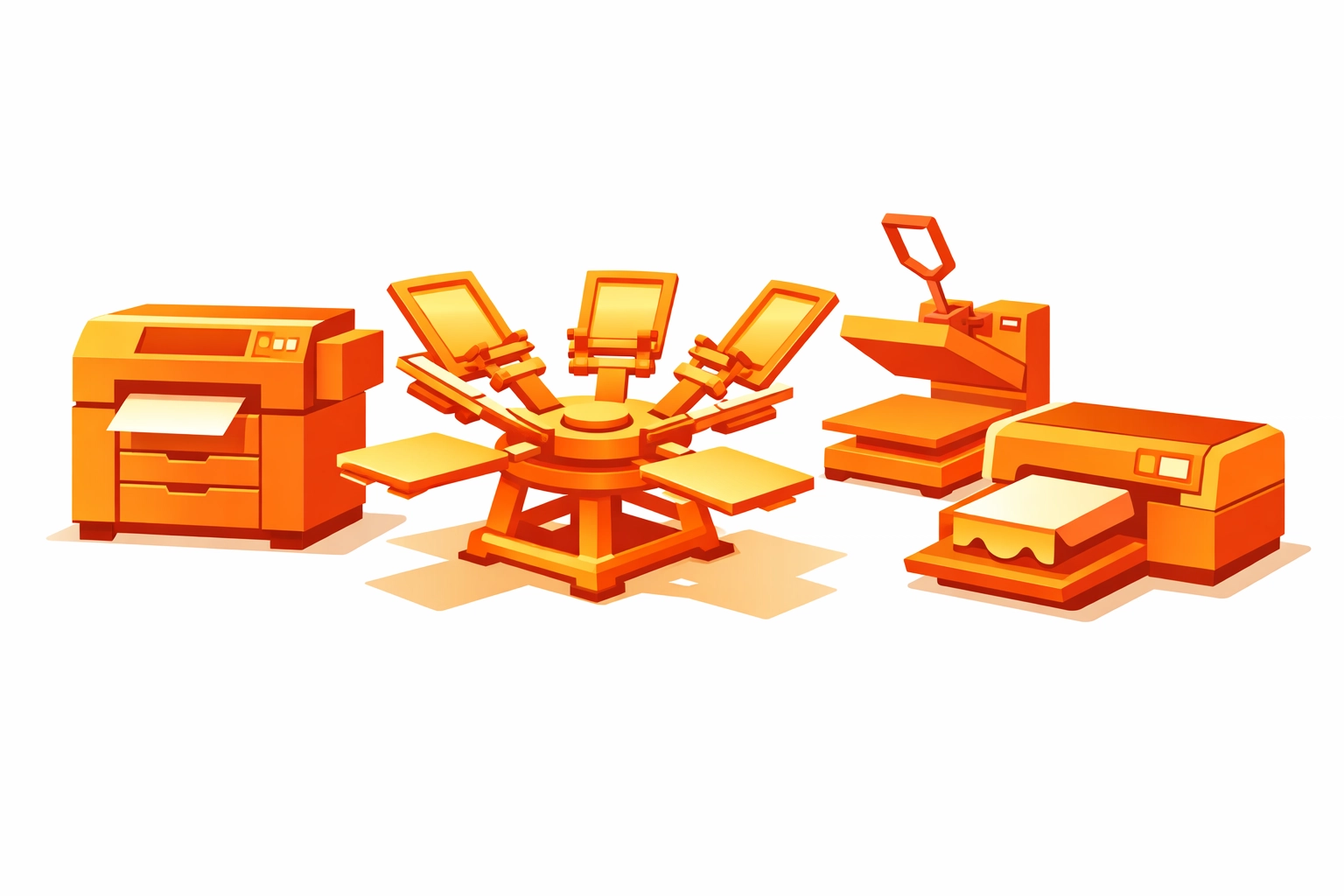
Equipment investment varies dramatically based on your service portfolio. Digital printing equipment ranges from $10,000 to $30,000, while screen printing presses cost between $2,000 and $10,000. Direct-to-Garment printers represent higher capital commitments at $15,000 to $30,000, though they enable premium service offerings that command higher margins.
Heat press machines offer an accessible entry point at $200 to $2,000, making them suitable for businesses testing market demand before committing to larger equipment investments. Digital color printers paired with paper cutters typically require combined expenditures of $6,000 to $18,000.
Leasing strategies provide an alternative to outright purchases, with monthly costs ranging from $200 to $500 depending on equipment type. This approach reduces initial capital requirements while maintaining operational flexibility, particularly valuable for businesses uncertain about long-term service mix or market positioning.
Initial consumables, including ink, toner, and paper stock, should be budgeted at $2,000 to $5,000. This ensures operational continuity during the critical early months when cash flow remains unpredictable.

Personnel and Payroll Planning
Scaled operations face substantial pre-launch payroll commitments. Marketplace platforms typically require $295,000 in payroll reserves covering six months of core team salaries, averaging $49,167 monthly. This covers executive leadership and engineering staff through platform launch phases.
These figures reflect the reality of competing for technical talent capable of building sophisticated platforms while simultaneously developing go-to-market strategies. Businesses can reduce these costs by outsourcing development or using fractional executive talent, though these approaches introduce different risk profiles around intellectual property control and strategic continuity.
Physical Operations and Overhead
Office and workspace setup costs approximately $30,000 for scaled operations, comprising $25,000 for furniture and equipment and $5,000 for software licenses and CRM tools. Real estate costs vary significantly by location. Suburban commercial spaces around 500 square feet cost $5,000 to $15,000 annually, while comparable space in high-demand urban markets exceeds $25,000 yearly.
Monthly fixed overhead typically totals $6,900, including $3,500 for rent and $1,200 for legal and accounting services. Maintaining six months of overhead reserves ($41,400) provides essential runway before customer acquisition spending begins generating returns.
Brand Development and Market Entry
Brand identity development requires approximately $15,000 for logo design, style guides, and initial website design work. Launch marketing materials add another $10,000, totaling $25,000 for comprehensive brand establishment. These investments set the foundation for all customer-facing communications and market positioning efforts.
For marketplace platforms targeting scale, customer acquisition demands substantial upfront investment. A typical budget of $300,000 funds acquisition of 200 sellers at $500 customer acquisition cost each ($100,000) and 2,000 buyers at $100 each ($200,000). These figures assume digital marketing channels and performance-based acquisition strategies rather than traditional advertising approaches.
Strategic Implementation Timeline
Enterprise-scale operations typically follow a structured runway. Platform development and technology build occurs from January through June, with office setup and equipment procurement concentrated in March through May. Launch marketing and brand asset deployment happens in May through July, with projected break-even achievement by month nine.
This timeline assumes adequate capital reserves and continuous progress across parallel workstreams. Delays in technology development frequently cascade into delayed market entry and extended burn rates, making project management capabilities as critical as technical execution.
Risk Mitigation Strategies
The largest financial risks stem from fixed payroll commitments totaling $590,000 annually and upfront technology capital expenditures of $275,000. Businesses should maintain minimum cash buffers of three months of fixed overhead ($20,700) and ideally six months ($41,400) before scaling customer acquisition efforts.
Equipment-heavy businesses benefit from phased investment strategies. Starting with affordable or leased equipment and upgrading as volume justifies capital deployment reduces initial capital requirements while maintaining operational flexibility. This approach allows market validation before committing to premium equipment purchases.
Strategic cost analysis isn't about minimizing expenditures. It's about aligning capital deployment with growth objectives, competitive positioning, and risk tolerance. Multi-service creative businesses that master this alignment position themselves for sustainable scaling rather than unsustainable growth that depletes capital reserves before achieving market traction.
Works Cited
Marblism Research. "Startup Cost Analysis for Print Industry Businesses at Scale." Print Industry Financial Analysis, 2026.
PRINTING United Alliance. "Financial Planning for Print Service Providers." Industry Best Practices Guide, 2025.
"Equipment Investment Strategies for Print Businesses." AIGA Business Resources, 2025.
"Capital Requirements for Creative Service Marketplaces." Print Industry Trends Report, 2026.
Recent Comments