
Production capacity management has always been a balancing act. You need to maximize equipment utilization while minimizing downtime, maintain quick turnaround times without sacrificing quality, and accommodate both large-scale runs and custom orders without destroying your profit margins. Traditional print workflows force you to choose between efficiency at scale and flexibility for smaller jobs. Hybrid print workflows eliminate that trade-off entirely.
The Fundamental Shift in Production Logic
Hybrid workflows represent a departure from the sequential, specialized approach that has dominated print production for decades. Instead of moving work through separate stations for printing, coating, cutting, and finishing, hybrid systems consolidate these operations into integrated processes. This consolidation changes the fundamental economics of how you allocate production capacity.
The integration matters because transition time between jobs becomes your enemy in a diversified order environment. Every time you switch from one product specification to another, you lose productive capacity to changeovers, adjustments, and quality checks. Hybrid systems compress these transitions dramatically, which means you can handle more diverse work without proportionally increasing your overhead.
Setup Times Drive Real Capacity Constraints
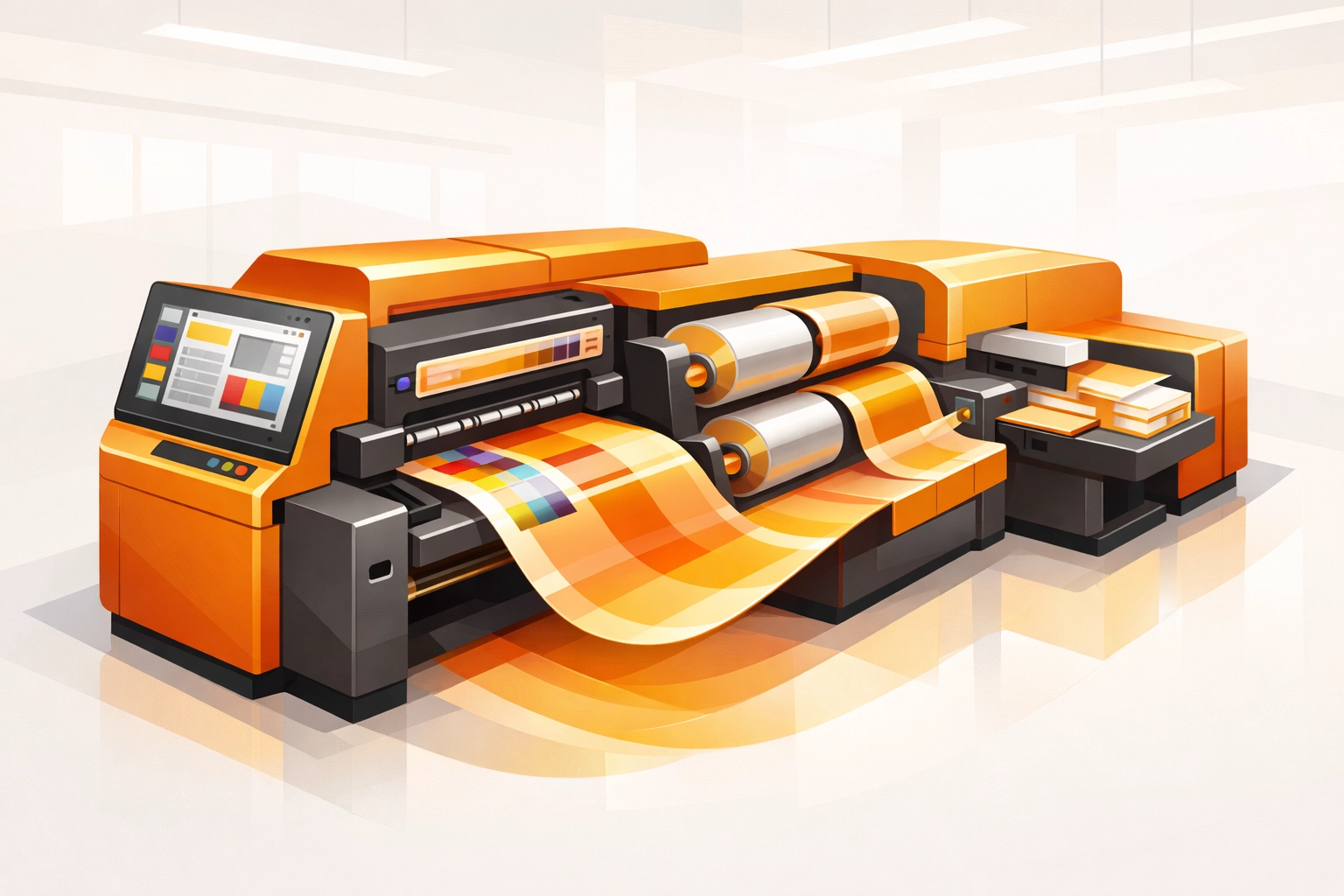
Traditional flexographic printing requires photopolymer plates or elastomer sleeves as image carriers. These aren't just expensive. They create a fixed cost barrier that makes short runs economically inefficient. You need to amortize the plate cost across enough units to justify the setup investment, which naturally pushes you toward longer runs and fewer SKUs.
Hybrid printing removes the plate requirement entirely. Setup times can be reduced to under five minutes consistently, according to PRINTING United Alliance research. That number matters because it changes what constitutes a viable job. When setup takes hours and involves hundreds of dollars in tooling costs, you can't profitably run 500 units. When setup takes five minutes and requires no custom tooling, suddenly that same 500-unit run becomes attractive business.
This shift opens up market segments that traditional workflows simply can't service profitably. Custom packaging, limited edition products, seasonal variations, and test marketing runs all become feasible without sacrificing your production schedule.
Automation Multiplies Labor Efficiency
Labor represents one of your largest variable costs in print production. The more manual touchpoints required per job, the more labor hours you need to schedule, and the more susceptible you become to quality variation and human error.
Hybrid systems incorporate automated labeling, finishing, coating, cutting, and packaging features as integrated components rather than separate downstream processes. This automation doesn't just reduce headcount requirements. It changes how you sequence work through your facility.
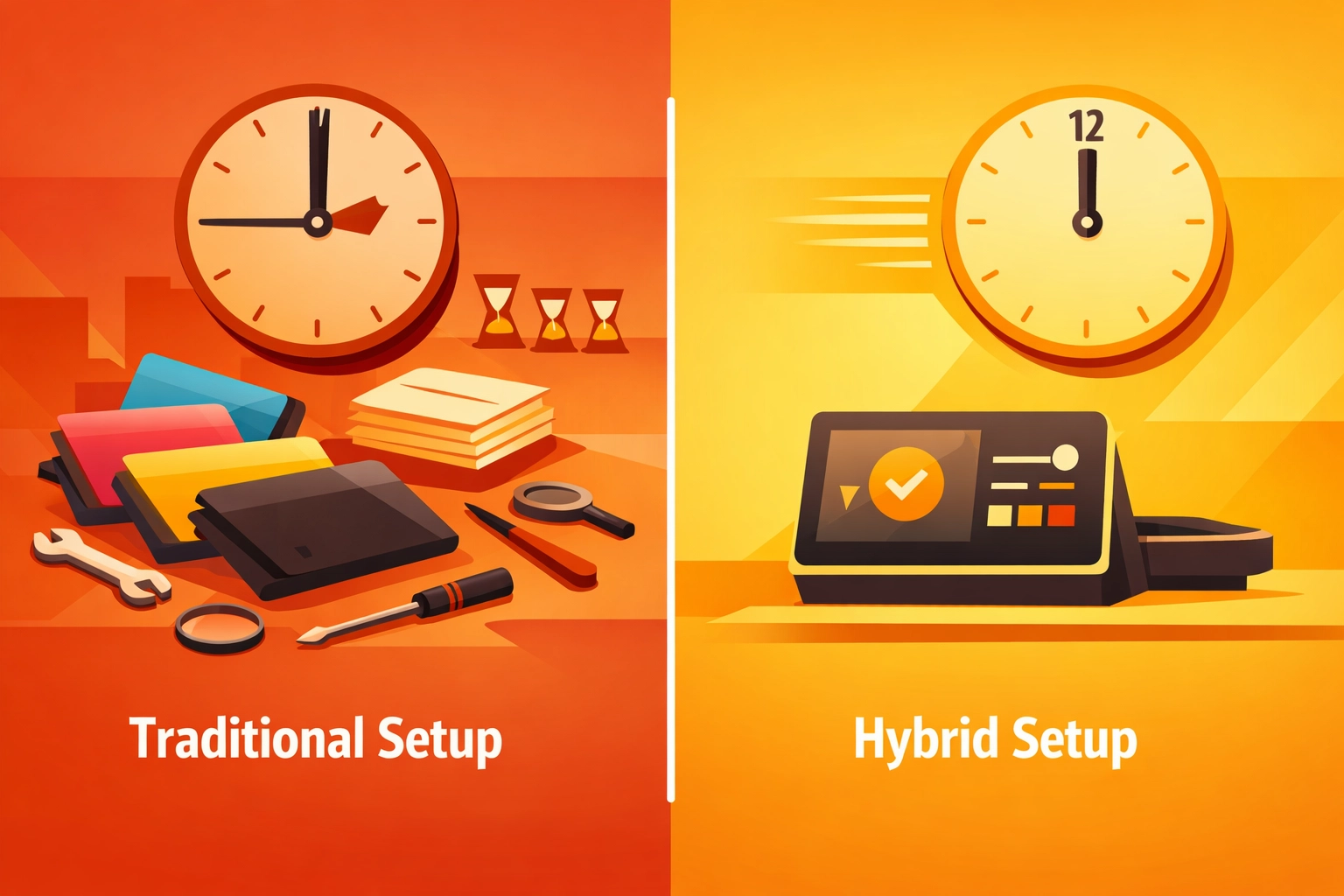
When one job finishes, the next can begin immediately with pre-programmed settings. You don't need operators to reconfigure multiple machines or move materials between work centers. Your labor shifts from hands-on production to supervision and quality control. That distinction matters for both cost structure and scalability.
A single operator can manage multiple concurrent processes instead of babysitting individual operations. Your bottleneck shifts from labor availability to machine capacity, which is a more predictable and controllable constraint.
Flexibility Beyond CMYK Standard Configuration
Production capacity isn't just about throughput volume. It's about the range of specifications you can accommodate without retooling or buying specialized equipment.
Hybrid workflows support color options beyond standard CMYK, variable web widths, and specialized inks within the same system architecture. This versatility means you can optimize capacity allocation across different product categories without being locked into specific configurations.
The business implication is significant. You can say yes to more orders without expanding your equipment footprint. Each piece of equipment becomes more productive because it can handle a wider variety of work. Your effective capacity increases even if your square footage and capital investment remain constant.
Waste Reduction Changes Job Economics
Material waste directly impacts your cost of goods sold on every job. Traditional workflows generate waste during setup, calibration, changeovers, and production overruns to account for finishing losses.
Hybrid systems reduce waste at multiple points in the process. No printing plates means no plate disposal or storage. Integrated finishing reduces material handling damage. Digital components enable precise quantity production without the overrun buffers required by analog processes.

Lower waste improves margins on every job, but the impact scales differently across order sizes. For large runs, waste reduction might improve margins by a few percentage points. For small runs, it can mean the difference between profit and loss. That distinction matters when you're evaluating which market segments to pursue.
Strategic Capacity Planning Implications
Adopting hybrid workflows changes how you should think about capacity planning and capital allocation. Traditional approaches optimize for throughput on standardized product specifications. You buy equipment sized for your typical order volume and adjust staffing to match demand fluctuations.
Hybrid workflows optimize for flexibility and range instead. You invest in systems that can handle the widest variety of specifications with minimal changeover costs. This shifts your competitive advantage from volume efficiency to specification accommodation.
The strategic question becomes whether your market values standardized products at high volumes or customized products at moderate volumes. Most markets are moving toward the latter, which makes hybrid workflows increasingly relevant regardless of your current production model.
Implementation Considerations for Existing Operations
Transitioning to hybrid workflows doesn't require abandoning your existing equipment fleet overnight. The most successful implementations integrate hybrid capabilities strategically to complement existing strengths.
Start by identifying which jobs currently strain your profitability due to setup costs or production constraints. These represent your best opportunities for hybrid workflow adoption. You can maintain conventional equipment for work that already runs efficiently while routing problematic jobs through hybrid systems.
This staged approach reduces implementation risk and provides immediate ROI on hybrid investments. You're not betting your entire operation on a new technology. You're solving specific capacity constraints that currently limit your growth or profitability.
The Competitive Timeline Question
Industry adoption of hybrid workflows will reshape competitive dynamics in print production. Early adopters gain the ability to serve market segments that competitors can't profitably address. Late adopters risk becoming locked into shrinking market segments where price competition intensifies.
The transition won't happen uniformly across all print categories or geographic markets. Your decision timeline depends on your customer base, competitive environment, and growth strategy. However, understanding the capacity management advantages of hybrid workflows positions you to make informed investment decisions as your specific market evolves.
Production capacity management will always involve trade-offs, but hybrid workflows fundamentally alter what those trade-offs look like. The question isn't whether to adopt hybrid approaches eventually. It's whether your market timing and competitive position make adoption strategically advantageous now versus later.
Works Cited
PRINTING United Alliance. "Hybrid Printing Technology: Integration and Automation in Modern Print Workflows." PRINTING United Journal, 2025.
Specialty Graphic Imaging Association. "Production Efficiency Metrics in Digital and Hybrid Print Systems." SGIA Technical Report, vol. 12, no. 3, 2025, pp. 45-62.
American Institute of Graphic Arts. "Economic Analysis of Print Production Methods: Comparing Traditional and Hybrid Approaches." AIGA Design Business Review, 2025.
Smithers Pira. "Hybrid Printing Market Analysis: Technology Adoption and ROI Benchmarks." The Future of Print Production, 2025, pp. 112-134.
Recent Comments