
The question echoes through design studios and print shops across the industry. Walk into any modern production facility, and you will notice something different from operations even five years ago. Traditional offset presses sit alongside digital systems, workflow software replaces paper job tickets, and conversations about automation have shifted from theoretical to operational.
Traditional print methods are not dead. However, they are being systematically displaced in specific applications as the industry undergoes a fundamental restructuring of how work moves through production environments. This shift reflects changing market demands, technological capabilities, and economic pressures that design studios can no longer ignore.
The Numbers Tell a Clear Story
Digital printing has become the fastest-growing segment of the global print market. Industry projections indicate digital print value will increase from $167.5 billion in 2025 to $251.1 billion by 2035, representing nearly 50% growth over a decade. Production inkjet has emerged as the preferred technology for short-run, on-demand, and variable data applications.
More than half of print service providers now operate inkjet systems, with another 20% planning adoption by 2026. These statistics matter because they reveal where investment dollars and strategic focus are moving. Traditional offset printing maintains value for high-volume work where color consistency and established reliability remain critical. But the economics have shifted for everything else.
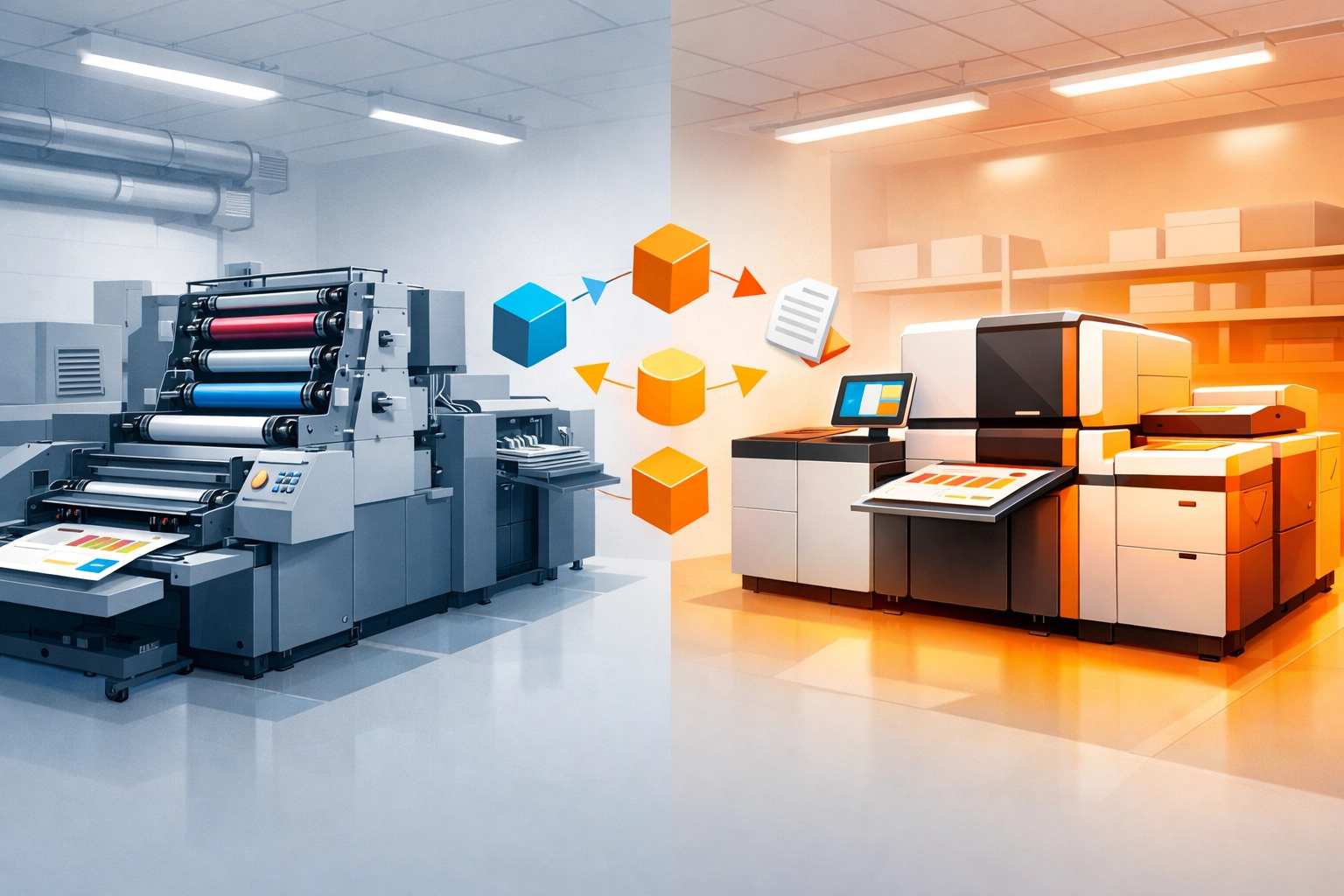
The displacement is selective rather than universal. Offset printing continues to dominate packaging, large commercial runs, and applications where tactile quality and color depth justify the setup costs. Digital methods have captured the growing segments of personalized marketing materials, short-run publications, and variable data printing where traditional methods cannot compete economically.
Why Studios Are Restructuring Production
Design studios and print providers are rethinking workflows for reasons that extend beyond simple technology adoption. The drivers are interconnected, creating compounding pressure for operational change.
Efficiency gains translate directly to bottom-line improvements. Printers migrating from traditional to digital methods report an average 9% reduction in paper waste and 8% increase in profit margins. These improvements stem from reduced setup times, minimized makeready waste, and the ability to print exact quantities rather than building in overruns for insurance.
Automation and AI-powered workflow systems reduce human errors at multiple touchpoints. Job tracking becomes more accurate, setup times decrease, and quality control improves through automated color management and real-time monitoring. For studios managing dozens or hundreds of jobs simultaneously, these operational improvements matter significantly.
Market demand has evolved in ways that favor digital production. Personalization shifted from competitive advantage to customer expectation. Brands now require variable data printing for targeted campaigns, on-demand fulfillment for inventory reduction, and quick turnarounds that traditional methods cannot accommodate profitably.

Digital printing's flexibility enables cost-effective customization at scales that would be economically unfeasible with offset printing. A 500-piece direct mail campaign with 500 unique versions becomes viable. Product packaging can include batch-specific QR codes or serialization. Publication runs can match actual demand rather than projected volumes.
Labor Pressures Drive Technological Solutions
The industry faces significant workforce challenges that make automation essential rather than optional. Experienced offset press operators are aging out of the workforce faster than new technicians enter the field. The specialized knowledge required for traditional printing represents a barrier that fewer workers choose to overcome.
Smart presses with predictive maintenance, automated color calibration, and AI-powered quality control help offset these skill shortages. A less-experienced operator can achieve consistent results with digital systems that would require years of training on traditional equipment. This reality influences equipment purchasing decisions regardless of other considerations.
Studios also face pressure to maintain productivity with leaner teams. Automation enables smaller workforces to handle higher job volumes with fewer errors. The economic equation favors systems that reduce labor dependency while maintaining or improving output quality.
The Hybrid Approach Gains Traction
Rather than wholesale replacement, many successful studios are embracing hybrid printing strategies that leverage advantages from both traditional and modern methods. This approach is growing rapidly, with the hybrid printing market expected to reach $10.2 billion by 2028.
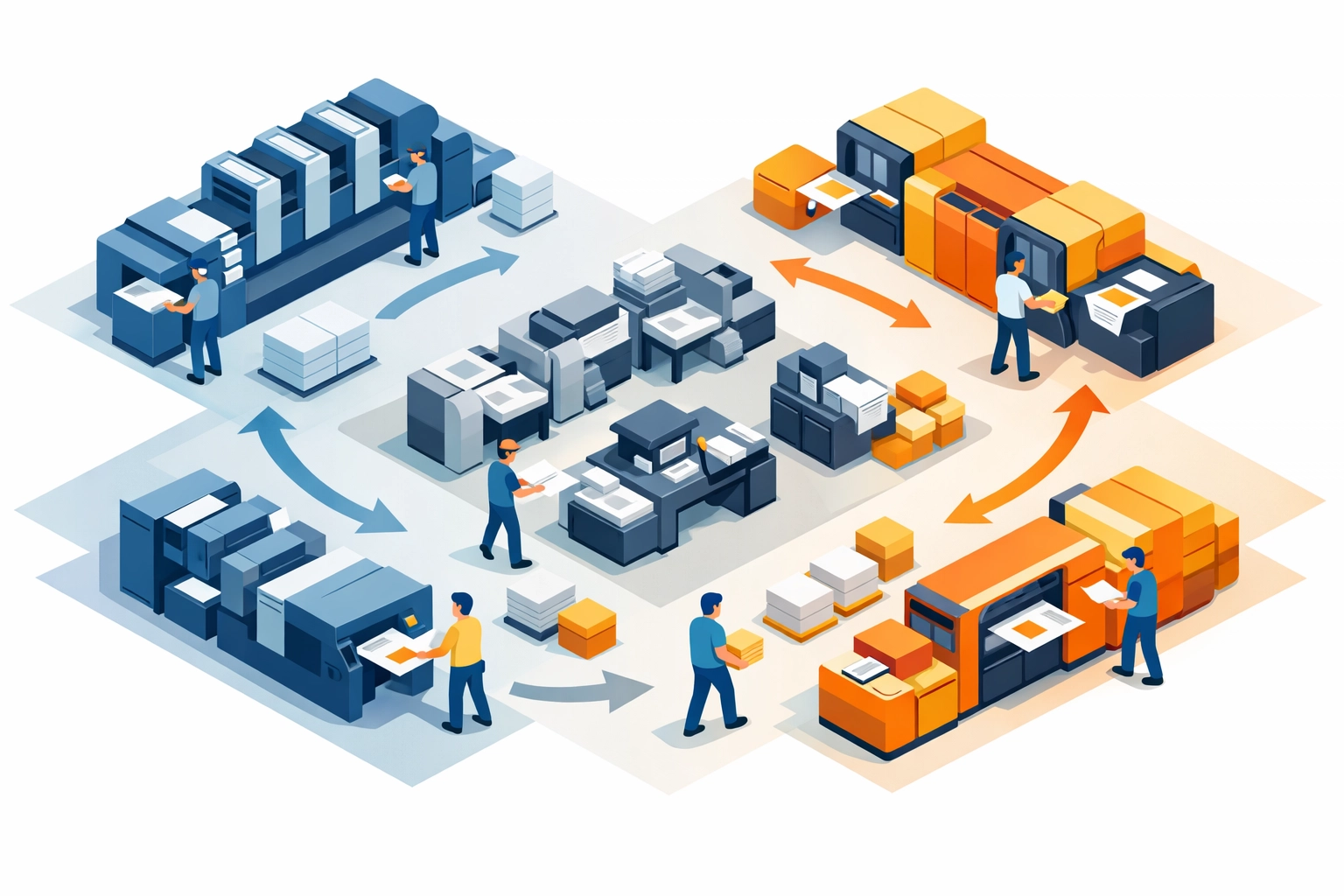
Hybrid workflows allow studios to route jobs to the most appropriate production method based on volume, substrate, finishing requirements, and turnaround time. A single client project might use offset printing for the primary run and digital for personalized versions or rush reprints. Combining technologies maximizes equipment utilization and provides flexibility that single-method operations cannot match.
The technical capabilities of hybrid systems continue to advance. Modern equipment can switch between printing modes, integrate inline finishing, and manage complex color matching across different technologies. Studios investing in hybrid capabilities position themselves to accept broader project types without outsourcing or turning away work.
Strategic Implications for Design Studios
Studios must evaluate production workflows through a strategic lens rather than simply responding to technology trends. The questions extend beyond which equipment to purchase.
What client needs are currently being underserved due to production limitations? Many studios discover that workflow constraints, not creative capabilities, limit their service offerings. A client requesting 200 personalized event invitations might receive a quote based on a 500-piece minimum because traditional methods make smaller runs unprofitable. Digital capabilities remove these barriers.
How does production efficiency affect competitive positioning? Studios with streamlined digital workflows can offer faster turnarounds and lower minimums than competitors still optimized for traditional methods. This advantage matters significantly in markets where speed and flexibility drive purchasing decisions.
What investments generate measurable returns? Equipment costs are substantial, but the calculation must include reduced waste, improved margins, expanded service capabilities, and labor efficiency. Studios reporting successful transitions cite concrete financial metrics rather than abstract technology benefits.
Navigating the Transition
The path forward requires assessment of current capabilities, honest evaluation of market positioning, and strategic investment planning. Studios should begin by analyzing job mix to identify which projects generate profits and which strain resources under current workflows.
Traditional methods retain advantages for specific applications. Abandoning offset capabilities entirely may limit options for high-volume work or substrates where digital printing faces technical limitations. The goal is optimization, not wholesale replacement.
Training represents a critical but often underestimated component. Staff accustomed to traditional workflows need time and support to adapt to digital systems. The operational benefits of new equipment only materialize when teams understand how to maximize capabilities.
The Verdict on Traditional Methods
Traditional print methods are not dead, but their role in production workflows is contracting. The decline is most pronounced in short-run commercial work, personalized marketing materials, and applications where quick turnarounds and variable data create value.
Smart design studios recognize this shift as an opportunity rather than a threat. By rethinking production workflows around hybrid capabilities, automation, and market-driven flexibility, studios position themselves for sustainable growth in an evolving industry. The question is not whether traditional methods will disappear entirely, but rather how studios will strategically balance traditional quality with digital efficiency to meet client needs profitably.
Studios that cling to traditional methods exclusively risk losing relevance in growing market segments. Those that abandon traditional capabilities entirely may forfeit profitable high-volume work. The future belongs to operations that thoughtfully integrate both approaches based on strategic analysis rather than technological nostalgia or uncritical adoption of new methods.
Works Cited
PRINTING United Alliance. "The State of the Industry Report 2025." PRINTING United Alliance, 2025.
Keypoint Intelligence. "Production Print Forecast: Digital Printing Market Growth 2025-2035." Keypoint Intelligence, 2024.
Smithers Pira. "The Future of Global Printing to 2035." Smithers Information, 2025.
AIGA. "Design Business and Ethics: Production Methods in Modern Studios." AIGA Professional Resources, 2024.
Graphics Pro. "Hybrid Printing Technologies: Market Analysis and Projections." Graphics Pro Magazine, vol. 42, no. 3, 2025, pp. 34-41.
PrintWeek. "Digital Transformation in Print Service Providers: Efficiency and Profitability Metrics." PrintWeek International, Jan. 2026.
Recent Comments