
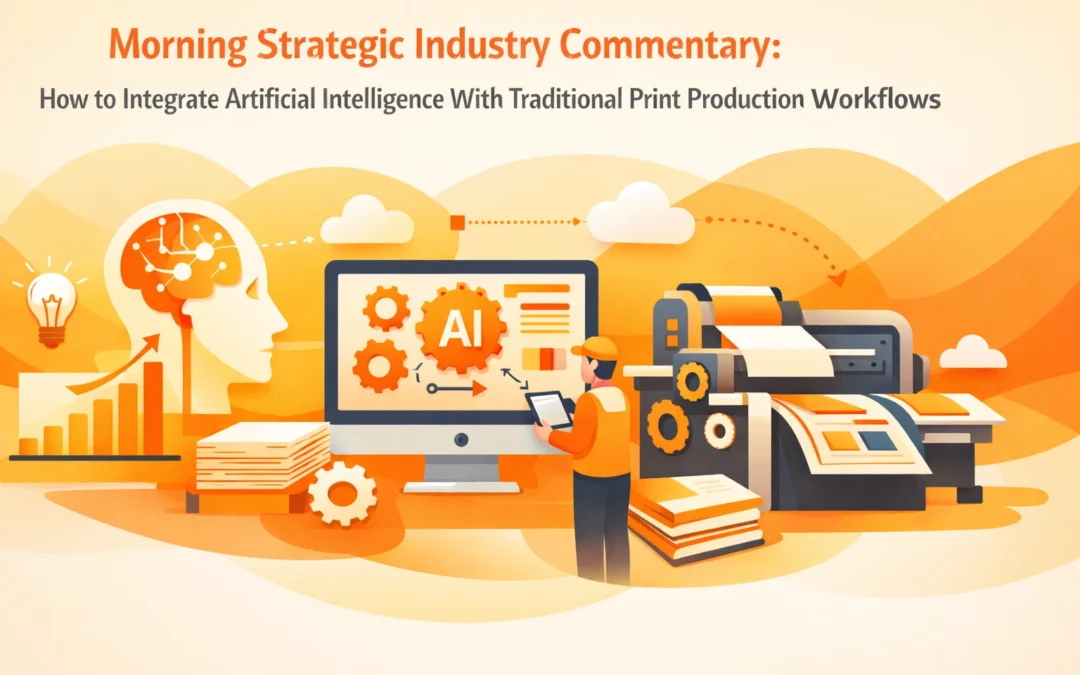
The print industry has undergone several radical transformations since the advent of digital press technology. Today, we stand at the precipice of another shift that is perhaps more significant than the transition from offset to digital. Artificial Intelligence (AI) is no longer a speculative concept reserved for software giants or experimental laboratories. For the modern print production facility, AI represents a strategic imperative that promises to solve chronic inefficiencies in labor, material waste, and scheduling. At Creative Design Hub (84G), we recognize that the successful integration of these tools requires a disciplined approach that balances cutting-edge technology with the proven mechanics of traditional print production.
The Strategic Assessment of Workflow Bottlenecks
The first step toward AI integration is not the purchase of new software, but a rigorous audit of existing workflows. Many print shops operate with legacy systems that create data silos, where information from the sales department rarely flows seamlessly into the prepress or finishing stages. To effectively implement machine learning models, a facility must first identify where the greatest friction exists.
Strategic planning begins by evaluating customer inquiry response times, the frequency of prepress errors, and the volume of substrate waste during the make-ready process. When a facility understands its baseline metrics, it can select AI solutions that address specific pain points rather than attempting a wholesale overhaul that might disrupt production. This analytical phase ensures that the technology serves the business goals of Creative Design Hub (84G) rather than adding unnecessary complexity to the shop floor.

Phased Deployment and the Pilot Program Approach
A common mistake in the graphic design and print sector is the attempt to automate every department simultaneously. This approach often leads to employee fatigue and systemic failures when incompatible software versions clash. A phased deployment allows for controlled testing and incremental gains.
A pilot program should focus on a single department, such as estimating or digital prepress, where the impact can be measured quickly. By implementing AI-driven estimating tools, a firm can analyze years of historical data to generate quotes that reflect true production costs and current market volatility. Once the pilot proves successful, the logic and data structures can be expanded to other areas of the business. This methodical rollout reduces financial risk and allows the production team to build confidence in the new tools.
Optimizing Prepress and Intelligent Job Planning
Prepress remains one of the most labor-intensive segments of the print workflow. It is also the area where human error is most likely to result in costly reprints. AI-powered prepress tools are now capable of performing advanced imposition layouts that minimize paper waste far more effectively than manual calculations. These systems analyze the specifications of a job, including trim size, bleed requirements, and the specific capabilities of the press, to create the most efficient layout possible.
Beyond imposition, computer vision and machine learning algorithms can detect low-resolution images, font substitutions, or color profile mismatches before a single sheet of paper is fed through the press. By automating these "pre-flight" checks, skilled prepress technicians can focus on more complex creative tasks and high-level problem solving. For those interested in seeing how these high standards translate to finished products, our portfolio at https://www.84g.net/project showcases the precision required in modern creative services.
Enhancing Production with IoT and Predictive Maintenance
Integration does not stop at the software level. The physical pressroom benefits immensely from the Internet of Things (IoT) combined with AI diagnostics. Modern printing presses equipped with sensors can relay real-time performance data to an AI central hub. These systems monitor variables such as ink density, temperature, and mechanical vibration.
Predictive maintenance is a key outcome of this integration. Rather than waiting for a mechanical failure to halt production, AI algorithms identify patterns that precede a breakdown. The system can then alert the maintenance team to replace a part during a scheduled downtime period. This shift from reactive to proactive maintenance ensures that the facility maintains a high level of uptime, which is critical for meeting the tight deadlines common in the creative services industry.

Intelligent Inventory and Resource Management
The volatility of substrate costs and supply chain disruptions has made inventory management a high-stakes endeavor. Traditional "just-in-time" ordering is often insufficient when global logistics are unpredictable. AI-powered inventory systems utilize predictive analytics to forecast demand based on seasonal trends, historical order volumes, and even local economic indicators.
These systems can automatically trigger reorders for ink, paper, and finishing supplies to ensure that production never stalls due to a lack of materials. Furthermore, by optimizing the use of materials through better imposition and reduced make-ready waste, AI directly contributes to the sustainability goals of the organization. Lowering the environmental footprint of print production is no longer just an ethical choice; it is a business requirement for clients who demand sustainable practices from their partners at Creative Design Hub (84G).
Addressing the Workforce and Skill Gap
The successful integration of AI is as much a human challenge as it is a technical one. There is often an underlying fear among staff that automation will lead to job displacement. Leadership must reframe AI as a collaborative tool that augments human capability rather than replacing it.
Training is a critical component of the integration strategy. Staff must be educated on how to interpret AI-generated data and how to intervene when the system flags an anomaly. Recruiting talent with a background in data science or digital workflow management is also becoming increasingly important. By fostering a culture of continuous learning, a print facility can ensure that its workforce remains as modern as its equipment. Our commitment to professional excellence is reflected in the way we manage our internal processes and our external projects, such as the Nurse Ed 101 initiative.

Quality Control and Real-Time Adjustments
Quality control has traditionally been a manual process involving periodic pulls from the delivery end of the press. This method is inherently flawed because hundreds or thousands of sheets may be printed between inspections. AI-integrated quality control systems utilize high-speed cameras to inspect every single sheet as it passes through the press.
These systems compare the printed sheet against the original digital file in real time. If a nozzle on an inkjet head clogs or if an offset plate begins to wear, the AI detects the deviation immediately. In some advanced configurations, the AI can even make autonomous adjustments to the ink keys or registration settings to correct the issue on the fly. This level of precision ensures a level of consistency that was previously unattainable, providing clients with the confidence that their brand colors will be identical across every piece of the print run.
Strategic Financial Impacts and ROI
Investing in AI requires a significant capital outlay, but the return on investment (ROI) is often realized through multiple channels. The reduction in substrate waste and the elimination of reprints provide immediate cost savings. Perhaps more importantly, the increase in production capacity allows the firm to take on more work without a proportional increase in overhead or labor costs.
Furthermore, the data generated by AI systems provides management with unprecedented visibility into the profitability of different job types. By analyzing which categories of work offer the best margins and the lowest error rates, Creative Design Hub (84G) can refine its market strategy to focus on high-value sectors. Information on our comprehensive service offerings and how we apply these professional standards can be found at https://www.84g.net.
Conclusion: The Future of Integrated Print
The integration of Artificial Intelligence into traditional print production is not a trend that will fade. It is the new foundation for the industry. Firms that embrace these technologies will find themselves more agile, more profitable, and better equipped to handle the complexities of modern graphic design. By focusing on strategic assessment, phased deployment, and workforce development, the print industry can ensure that the "traditional" aspects of the craft are preserved and enhanced by the power of digital intelligence.
As we look toward the future of the industry, the goal remains the same: to deliver high-quality, impactful physical media that meets the evolving needs of our clients. AI is the tool that will allow us to achieve that goal with greater precision and sustainability than ever before.

Works Cited
AIGA. "The Impact of Automation on Graphic Design and Production." AIGA Design Educators Community, 2024, www.aiga.org.
PRINTING United Alliance. "AI and Machine Learning in the Modern Pressroom: 2025 Industry Report." PRINTING United Alliance Research Series, 2025, www.printing.org.
Printing Industry Midwest. "Sustainability and AI: Reducing Waste in Commercial Print." PIM Insights, 2023, www.pimw.org.
Smithers. "The Future of Global Printing to 2030." Smithers Market Reports, 2024, www.smithers.com.
Recent Comments